Developer: Acclaim Studios Teesside Publisher: Acclaim
Released: August 31, 1999 Rated: M 7/10
In Acclaim’s acquisition of Valiant Comics and their games based on the characters therein, we find the grand success of the Turok franchise at one end of the spectrum. On the other, the sloppy and forgettable Armorines: Project S.W.A.R.M. And somewhere in the middle or perhaps on another plane entirely, we find the darkest and most intense of the bunch in Shadow Man. Developed by a team previously branded as Iguana UK, the studio was working on a game engine in isolation when Acclaim supposedly brought them a selection of eight different Valiant IPs they could put it to use on. This relative sense of freedom seems to have worked out well as it seems like the team could choose a franchise they could see themselves putting a lot of passion and creative juices into, and why Shadow Man really deserves to be considered a dark and unexpected gem for the Nintendo 64 library lacking in truly mature titles worth coming back to.
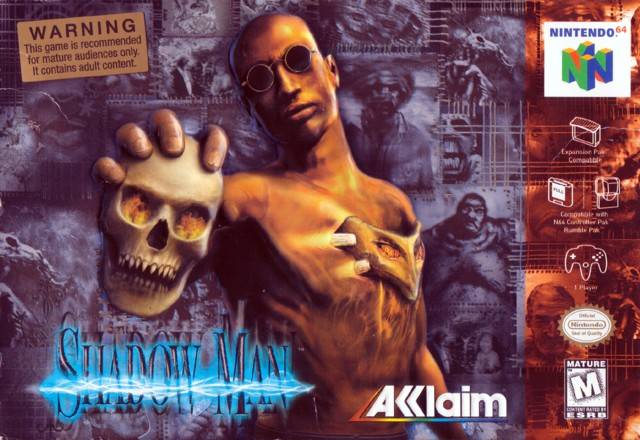
Shadow Man is not shy about what it wants to be, even going so far as to self-impose a parental advisory sticker on it two years before Conker’s Bad Fur Day would do the same, and this on a cover featuring our protagonist holding a human skull out to the player while his naked torso bears a pattern of grotesque scars and a sinister-looking mask fused to his chest. I don’t think there’s any confusion to be had here: this is going to be intense. Without getting too deep into the bonkers storyline that seems more than fitting for a Valiant property or for comic books in general, this intense-looking man on the cover is Michael LeRoi, the current incarnation of the warrior known as the Shadow Man. Bearing the Mask of Shadows on his chest and infused with the power of ancient gods to roam between the planes of the living and dead known as Liveside and Deadside, protecting the balance between the two and fighting back the forces that would seek to disrupt that balance. The evil force that threatens the worlds in the game is known as Legion, and plans to utilize a team of serial killers hand-picked from across recent history to try to achieve his goals and bring about the apocalypse so it may control both planes of existence. It’s really heavy stuff, to say the least, and the fact that each member of The Five, as they’re referred to, are based on real life serial killers like Ed Gein and even use Jack the Ripper himself in the game is a really strong indicator of the game’s tone and themes that are used very effectively

This all comes across really well in execution, as Shadow Man boasts some wildly varied settings between the Liveside and Deadside areas as Mike travels between them, always delivered with excellent style and atmosphere that runs really consistently throughout the game. Regardless of which plane you’re on, there’s a palpable dreariness and darkness, and it comes through a strong attention to detail, effective level design, visual style, and use of music. Composer Tim Haywood did some incredible work with the soundtrack both in getting some big and complex tracks out of the N64’s limited memory, as well as using both fuller instrumental and choral tracks in contrast with ambience to make a compelling and unnerving backdrop. Unlike a lot of “ambient horror OSTs” from any era, there’s only some spots that predominantly use silence or overly sparse audio. Many tracks that are more dissonant still use sound effects and such to create a full backdrop that I appreciate, especially as the visual design often does the same on a console where open and empty can be too much of a default choice because the hardware pushes in that direction.

This “more is more” philosophy plays really well in contrasting the two types of areas you’ll be exploring between the two planes, and also feeds somewhat into the gameplay, which is best described as something of a Zelda-like or even a 3D Metroidvania type of adventure. Yes, this does mean lots of backtracking, which is the first thing worth bringing up if you don’t think you’ll like what Shadow Man does. It’s a downright labyrinthian game particularly in the world of Deadside where you’ll be exploring essentially one large interconnected map until you make it to the next dungeon or transfer back to your next task in Liveside. And no, dungeons on either side of the game are not on the level of Ocarina of Time. But they are loaded with various sections of combat, puzzles, exploration, and platforming challenges in a varied and atmospheric set of environments that are really worth working your way through. A abandoned and disheveled New York apartment building, a skin-melting industrial furnace, a swampy bayou on the Mississippi delta, a Giger-esque hall of torture and pain, and a down and dirty Texas prison facility are just some of the areas that Mike will have to go through in his quest to acquire items and abilities while fighting the members of The Five and eventually, take down Legion, and it’s worth the frustration of seeing so much of them so many times over to enjoy the style that Shadow Man brings to the table.

Now, of course, being compared to Zelda, Metroid, and Castlevania is not going to do Shadow Man any favors when discussing the moment-to-moment gameplay, and the team Teesside doesn’t beat the allegations working under Acclaim and its propensity for jankiness. It does take some notes from these series, particularly a copycat Z-targeting (R-targeting in this case) system for dealing with groups of enemies, which certainly works as intended, if a little clunkier than in Ocarina. Mike altogether moves with a bit more clumsiness than Link, Samus, or Alucard, but it’s Castlevania 64 where there’s probably the closest overlap. A game I also really like for the same reasons: a janky 3D adventure with a little too much platforming for its lack of control precision, but it’s not short on striking audio or visual design that goes a long way in a game with bones that slip just under the four star threshold. Shadow Man even goes one further in its presentation with not only the really exciting music, but even voiceovers that are both impressive for fitting onto the N64 and a cut above most of what one would expect from the time period. Although the actual writing is often both overly expository and comic-book-level insane, the VO has some solid effort behind it and it’s another feature that helps push you through the tough or frustrating moments of getting lost or fighting the controls when they’re at their least cooperative.
Acclaim’s legacy as a publisher has a lot of rough patches and it can even seem like any nostalgia for them has more to do with the fact that they haven’t been around for over 20 years to keep putting their name on blunders and bad marketing ideas. But even as a company with a mediocre-at-best hit rate, games like Shadow Man should probably make you miss an era where new gaming franchises (even if they’re technically based on existing IP) with such a well-expressed and interesting design philosophy right out of the gate were a regular treat from third-party publishers that would kill off a studio nowadays for a game with twice the return of a game like this.
Continuing Legacy
Teesside Studios made just one more game before their closure alongside Acclaim in 2004, the confusing-in-print sequel Shadow Man: 2econd Coming, which also involved one of Acclaim’s most baffling Nathan Fielder-esque marketing stunts I’d never have another chance to talk about: advertising on gravestones. Acclaim would pay the estate/relatives of the deceased for a small billboard to be placed on monuments. Already in pretty poor taste conceptually, they outright said that “poorer” families may take them up on the offer. Shadow Man received a remaster from Nightdive Studios in 2021 and a sequel, Shadowman: Darque Legacy, was announced in 2023, but has received little in the way of updates since.
Additional Information
Saves: Controller Pak
Players: 1
Compatible With: Rumble Pak, Expansion Pak
Print Guides: Acclaim
Aggregate Critical Reception (GameRankings): 73.26%, based on 19 reviews
Other Releases: EU, September 3, 1999
My Streams
Commercials and Print Ads


Gallery