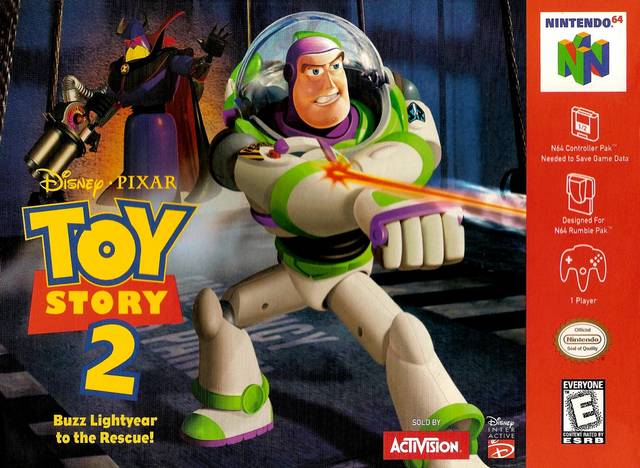
Developer: Traveller’s Tales Publisher: Activision
Released: November 16, 1999 Rated: E 7/10
I feel like many Disney adaptations, for good reason, fall into the habit of representing something of the “stock average concept” of a video game for their times. In the 8 and 16-bit eras, mostly Capcom-published efforts accounted for a set of almost-exclusively side-scrolling platformers, broken up every so often by a gimmick level or boss fight predicated on learning patterns and timing. In the era of the Playstation and N64, then, things evolved mainly into the 3D collect-a-thon style. Intentionally derivative, sure, but expecting a younger audience that can pick things up quickly based on familiarity with the Marios and Crash Bandicoots of their respective system.
Toy Story 2: Buzz Lightyear to the Rescue is your classic example of this for the N64, where collect-a-thons reign supreme in the minds of its fans. A 3D platformer where you play as one of the film’s primary characters and most viable action game candidate, Buzz. Armed with a working wrist laser and a glide-wing-enabled double jump, Buzz makes his way across the primary locations of the film and more in the search for Woody, and like any good adaptation of a 90-minute kids’ film, the amount of padding and riffing along the way is welcome. Buzz starts off at Andy’s house, exploring it quite literally from top to bottom and performing various missions to acquire the game’s primary collectible: Pizza Planet tokens. Across 10 levels and five boss fights, 50 tokens leaves a solid amount of content for a game of its scope, even if it’s a bit short of a Banjo-Kazooie or similar classic.

With levels based around the yards surrounding Andy’s house, Al’s Toy Barn, a construction yard, the airport tarmac, and more, there aren’t a lot of crazy, unexpected locations to see, but the care put into each one is admirable. Populated by Buzz’s friends like Hamm, Rex, and Bo, there are recurring gimmicks but plenty of variety to be had in platforming challenges, puzzles, and mini-bosses, though the challenge is understandably toned down a bit. Buzz’s arsenal isn’t exactly that of Donkey Kong and pals, sticking mainly to stuff like his spin attack and laser, the latter of which can be free aimed in a manner similar to Goldeneye. It’s pleasant, functional, and for fans of the film/franchise, it checks all the boxes you should need.
Aside from its expected concessions in the name of being accessible to a younger demographic, Toy Story 2 certainly isn’t perfect in its execution or its presentation. The everyday settings are a natural way for the game to work in some more content, and obviously it’s in Toy Story’s DNA to work off of the everyday, but things can certainly drift into the realm of being boring because of this tandem effect of simplicity and familiarity. I certainly won’t blame you if you read the list of levels from the last paragraph and let out a yawn. The exploratory pacing on top of it all certainly doesn’t get the blood pumping, either, except maybe in the boss encounters which introduce at least a little adrenaline.

That’s all certainly preference, though, and as a licensed game on the N64, if there are any true weak spots, it’s the presentation, particularly by comparison to disc versions and, well, the film, will be the biggest factor. To get the obvious out of the way: the PS1 and Dreamcast have FMVs, the N64 has stills. No surprises, but considering they’re actual movie clips being missed out on, it’s extremely noticeable. Speaking of actual movie assets, it’s almost to its detriment that the soundtrack includes an instrumental of “You’ve Got A Friend In Me” because the tracks afterwards, although they’re not really bad, stand out even worse as “video game songs,” if that makes sense. Tracks composed to fit a fairly generic description of a video game level, rather than adapted from a real, recognizable tune, with the caveat that they won’t distract too much from the gameplay so it’s almost trying to avoid being memorable even though it’s got a forefront beat and a melody. Oh, and the MIDI soundfont is considerably more noticeable because they were composed with it, rather than converted.
Toy Story 2: Buzz Lightyear to the Rescue also sits about a notch or two below its contemporaries in terms of control and playability. A little jank in the physics engine isn’t a huge issue, but worth noting nonetheless. There are moments where Buzz will miss platforms in tight spaces or jumps that are tough to land for what will feel like the wrong reasons. But mostly it’s his space boots — they make him so damn slippery for whatever reason. You’ll probably notice it right away, your man has a bit of a momentum issue that sticks out compared to other platformers, and that will be a particular learning curve in this game that, thankfully, is very forgiving in the early goings especially.

Seeing a score of 7/10 on a licensed game probably says most of what the next 800 words did already, but if you wanted to know why, there you have it. Nothing particularly strange to point out, no huge mistakes, missed opportunities, or innovations to the genre to stretch its appeal beyond what it says on the label. Toy Story 2: Buzz Lightyear to the Rescue is about as good as it needs to be, and you’re just as likely to keep playing it to the end because it’s easy and fairly short, as you are to ditch it after an hour because it’s not showing you anything you haven’t seen before. Well, besides the basement at Andy’s house.
Continuing Legacy
It’s almost too perfect to think that Toy Story 2: Buzz Lightyear to the Rescue was developed by none other than Traveller’s Tales. The DNA of the Lego franchise is certainly tangible within this game, as are their PS2 Crash Bandicoot games and other Pixar adaptations. Toy Story 2 might just be the most similar to their blocky cash cow, though, with this feeling like an overall looser and less-polished version of the games they would become best known for.
Additional Information
Saves: Controller Pak
Players: 1
Compatible With: Expansion Pak, Rumble Pak
Print Guides: BradyGames
Aggregate Critical Reception (GameRankings): 61.55%, based on 11 reviews
Other Releases: EU, February 4, 2000
My Streams
Commercials and Print Ads

Gallery