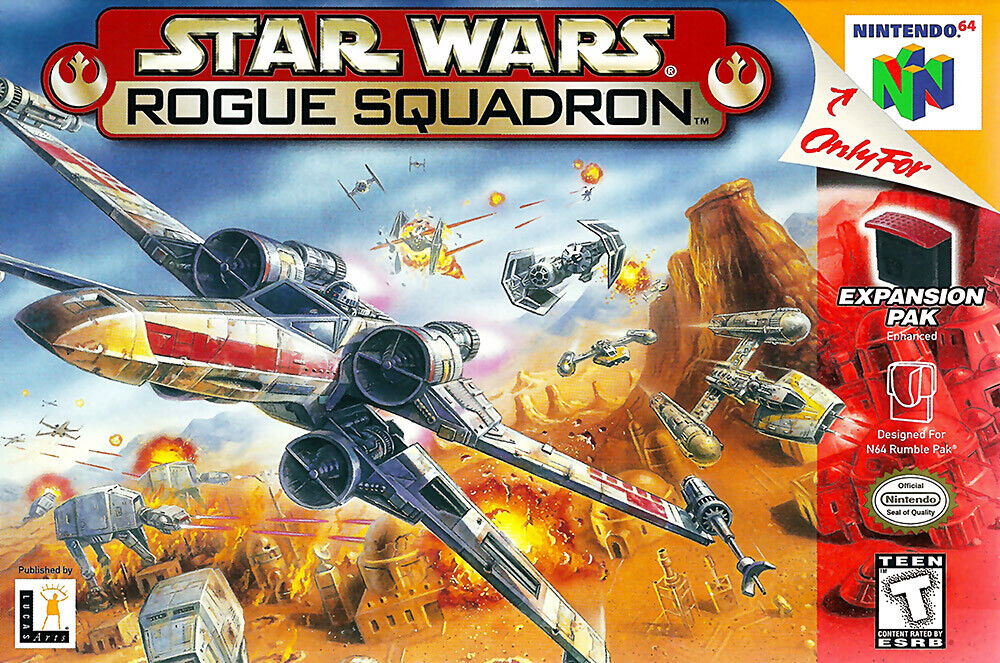
Developer: Factor 5, LucasArts Publisher: LucasArts
Released: December 8, 1998 Rated: T 9/10
There are a lot of supposed “technical marvels” on the N64, from its first declaration of intent with Mario 64, to the compression wizardry of Resident Evil 2, the expansive world-building of Majora’s Mask, and, in its own way, the peripheral tango of Pokemon Stadium and the Transfer Pak. In a number of its own ways, Star Wars: Rogue Squadron is another of the N64’s top technical achievements. A coming out party for the Expansion Pak, Factor 5 delivers not only one of the best-looking, but also the best-sounding and best-playing titles in the N64 library.
Inspired somewhat by the earlier X-Wing series on PC, Rogue Squadron’s true genesis and proof of concept lies in the much-heralded Hoth level that opens Star Wars: Shadows of the Empire, where players fly a fully-controllable Snow Speeder throughout the iconic battle and even take down Imperial Walkers with tow cables. Where many players lamented that the rest of Shadows wasn’t as polished as that opening flight mission, Rogue Squadron is the game to answer those complaints as a full campaign of flight missions across various locales and piloting a full fleet of beloved and lesser-known Star Wars spacecraft. And players will get a great look at these craft, from the beloved X-Wing and the functionally vital Speeder to the lesser known A-Wing and V-Wing. While draw distance has been pretty heavily sacrificed, these craft are given a ton of detail and care in their models, which is important as you’ll not only get a close up look at each in the hangar before every mission, but through the primary camera angle up behind your vehicle. Outside of the heavy distance fog, this is an excellent looking game starting with and looping back around to these craft, with solid models of every building, enemy, and fellow craft you’ll be flying over, attacking, or protecting. Even the textures are a good notch above most of its contemporaries, bringing the overall look of the game about on par with an early GameCube title – in other words, it’s a seriously good look for a 1998 N64 title and makes the Expansion Pak look like a powerhouse accessory well before it became mandatory just to play any major titles.

Hopping into your craft as Luke for a variety of missions taking place in between episodes IV and V, Rogue Squadron offers some of the most prime Star Wars gap-filling and free-reign story and setting concepts of the pre-Disney era. Alongside Wedge Antilles and the rest of Rogue Squadron, an intriguing plot – well, considering the limitations of storytelling between radio chatter, pre-mission briefings, and text crawls – we portray Luke across 15 primary missions with varied structure, focus, and locations that really make the overall conflict between the Rebellion and Empire feel properly encompassing and intricate. Rescuing a downed ally ship on Chorax, a prison break to spring a captured Wedge on Kessel, and numerous bombing runs and attacks to disrupt Imperial military production are some of your objectives, and LucasArts/Factor 5 do a great job showing off the galaxy in its vastness and variety, even while missions still only take place in small areas and on planet surfaces.
Rogue Squadron’s immersiveness and storytelling also benefit hugely from Factor 5’s truly impressive compression and sound technology that they were able to debut and show off with this title. Both music and recorded dialogue are a massive step above prior expectations of the hardware when playing Rogue Squadron, thanks to Factor 5’s MusyX and DivX middleware tools. In addition to actually creating the music themselves, Factor 5 was able to compress a true John Williams-esque score into the game instead of settling for the MIDI formats that were standard due to the cartridge-based hardware on the N64. It may not be as memorable and timeless as the score to something like the previous month’s The Legend of Zelda: Ocarina of Time, but it certainly stands out in the N64 library, along with the in-game dialogue and voiceovers. While Star Fox 64 had already done copious amounts of recorded voiceover over a year before, the presence of strong VA in Rogue Squadron also contributes to a really impressive production value worthy of the Star Wars moniker.

While Rogue Squadron is far from a serious flight simulator, in spite of its on-planet focus and other similarities to series like Ace Combat or its predecessors in the X-Wing franchise, it’s still an excellent playing title with fluid and fun controls. Care and tact is a serious must just to finish out a mission in one piece, and the challenge of acquiring medals to prove your acumen is downright intense, particularly in the epilogue missions. Knowing the craft and feeling the difference between them is key and balancing your weapon usage is just as important as accurate shooting and dogfighting skills, but it all feels great, up there with any other respected flight sim. Rolling over an Imperial base for a bombing run in a Y-Wing or trying to keep just the right angle while towing down an AT-AT just feels fun and challenging. A multitude of little mini game challenges like staring down AT-STs in self-imposed games of chicken or trying to up your kill count by bullseyeing fleeing Stormtroopers are little moments of fun amongst the overall seriousness of sticking to your objectives and listening to your squadmates to keep up with the action.

On a system with four excellent Star Wars titles, Star Wars: Rogue Squadron is probably the objective best, but it’s the variety of the four that makes that a lot harder to gauge than you might expect. Still, it’s a game that’s held up amongst its peers and kicked off an incredible trilogy of titles that kept Star Wars fans locked in on Nintendo’s efforts through this generation and the next, while even providing technical prowess for future titles on the system to benefit from. I don’t believe any Star Wars fan should go without experiencing at least one Rogue Squadron or affiliated title (such as Battle For Naboo), and even those without an interest in the series at least owe the companies behind it an honest salute for their efforts.
Continuing Legacy
Along with its sister entry on the N64, Episode I – Battle for Naboo, and its direct sequels Rogue Leader and Rebel Strike, Rogue Squadron or at least Factor 5/LucasArts are heralded for their technical prowess, as described above. There have, of course, been other Star Wars flight sims including the PS2 and Xbox’s Starfighter, as well as some key gameplay elements in both Star Wars: Battlefront series. The most direct sequel, however, is 2020’s Star Wars: Squadrons (hence the name), which certainly deserves a look, but most would agree that the Nintendo Rogue Squadron trilogy, even with its flat final entry, Rebel Strike, and its insistence on incorporating on-foot sequences, are some of the finest, along with the ‘90s PC titles X-Wing, TIE Fighter, et. al.
Additional Information
Saves: Cartridge
Compatible With: Expansion Pak, Rumble Pak
Players: 1
Print Guides: Nintendo Power
Aggregate Critical Reception (GameRankings): 84.25%, based on 16 reviews
Other Releases: EU, January 10, 1999
My Streams
Commercials and Print Ads