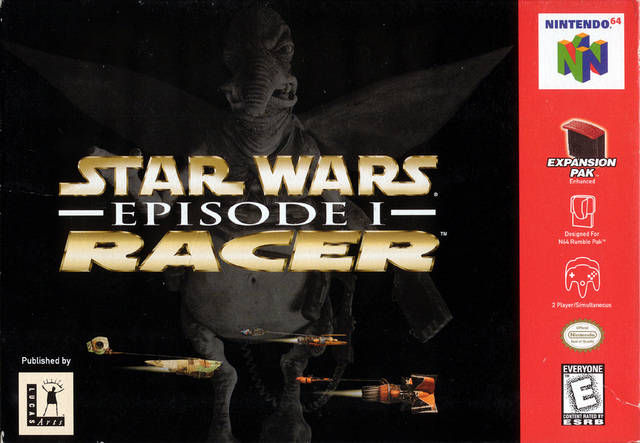
Developer: LucasArts Publisher: LucasArts
Released: May 18, 1999 Rated: E 8/10
Incredible to think that on a system with so many futuristic racing titles, including efforts from the likes of F-Zero and Wipeout, that a game affiliated with The Phantom Menace can put forth the claim to be the best of them. Arguably the one genre that Star Wars and its already lengthy resume in the world of games seemed incapable of covering, the introduction of the Lucasized version of the sport in Episode I seemed as much a merchandising ploy as anything else in the prequel trilogy, but with the capable hands at LucasArts at the helm, it’s no surprise that the inevitable video game tie-in delivers in another technical masterpiece that puts the hardware to brilliant use in the process.

Star Wars fans looking for their next hyperfixation character should look no further than here, with over 20 of the wildest designs in the series’ catalog on offer to jump in with or unlock over the course of a playthrough, which will also take you to eight different planets with distinct appearances and environments to dictate their different track designs. Whether you like the pilot or their base pod, you can usually get them to a point where you’ll enjoy using them via a basic but appreciated upgrade system. It’s not a deep set of tuning mechanics like street racing games would start to offer in the coming years, but paying Watto for fresh parts or saving a few truguts by digging old ones (that might die on you mid-race) out of the junkyard is a fun system. In a game that offers plenty of depth in how you perform while still boasting a fully unique identity outside of just relying on the branding, all of the systems at play can be easily appreciated even if they’re not bringing time-sink levels of complexity.

If there’s a true time-sink aspect of Episode I Racer, it’s right where you’d want it to be, as practice certainly makes perfect on the game’s intense and reflex-testing array of tracks. Branching paths, hairpin turns, moving hazards and mettle-testing jumps adorn the 21 tracks as the game pushes you to learn both the feel of your craft and the layout of the raceways. With an interesting damage system, Racer rewards clean driving as well as calculated risk taking. Hitting a wall at nearly 600mph is as disastrous as you’d expect, unlike lots of other arcade racers where you can just as easily use walls to course correct yourself. At the same time, damage accrued from a harsh landing off a jump, jockeying for position with other racers, or pushing your luck on a boost can be healed if you don’t go straight into a blowout, but at the cost of speed while your vehicle self-repairs. All in all, it’s a rewarding system of driving/piloting some of the series’ coolest inventions to date that differs in some ways from other futuristic racers without reinventing the twin-thruster engine.
The same can be said for how damn good the game looks and sounds. Comparing especially to F-Zero X, which makes choices like toning down the detail on its vehicles for the sake of frame rate and speed, or MIDI-orchestrated rock music to pump the adrenaline, Episode I Racer is a successful use of the hardware in the same genre but with different areas, and still delivers an excellent sense of speed and action as well. Though not having Factor 5 themselves on as a developer, the team at LucasArts uses that same MusyX compression technology to deliver intense orchestral tracks from or inspired by John Williams’ film score as well as fully-voiced dialogue clips of the contestants jabbering at each other throughout the action. The only real downside is that the music in-game doesn’t kick in until your final lap, an attempt to heighten the drama, but I’d rather have the music especially on the three-plus minute per lap races. Also, Watto hums the Cantina song and it’s been a vocal stim of mine for over 25 years now. The detail on the craft in the game also excellent, with fans being able to get a full view of all of them as needed from inside a mechanic bay, while excellent draw distance for a game at this level of performance and resolution via the Expansion Pak highlights the quality of the environments if you can get a chance to look past your racing line.

Perhaps Racer’s biggest detriment, then, is that it’s quite hard? Technically laid out across four cups, down to the intensely difficult final four races that almost feel like a sadistic bonus set of challenges for the last few characters in the game — notably Ben Quadrinaros and Sebulba as featured in the film — this is a tough and testing game that expects a lot from you in spite of an arcade feel. Thankfully, it isn’t divided into multi-race circuits that must be started fresh each time like most racing games. You only have to focus on and restart each race one at a time. It’s just that it can be tough not progressing anywhere else while one really rough track gives you a repeated run for your money. It’s also a far less appealing multiplayer racer than a lot of what you’ll find on the system, in my opinion. Splitscreen really does a number on this game in a way that even other futuristic games don’t suffer from quite as much, with a lot of the visibility really needed to feel in control really cut down when playing with another person, and only two players allowed at once anyway instead of four. Other than that, however, Star Wars – Episode I Racer is an impressive feat both in its ability to successfully pull off Star Wars and racing and to stand tall amongst other tremendous titles of its style, without necessarily feeling like it takes much from its contemporaries, either.
Continuing Legacy
Racer received successful ports to PC and Dreamcast as well as a Sega-developed arcade version that traded a little bit of complexity for the undeniable cool factor of a cabinet shaped like the cockpit of Anakin Skywalker’s machine and controls based on the dual thrusters previously simulated by an odd control scheme utilizing two N64 controllers and their respective control sticks simultaneously. A PS2 sequel by Rainbow Studios was the only other true title in the series, as Star Wars Super Bombad Racing shares little DNA with this title. Aspyr offers Episode I Racer among their many remasters for eighth-generation consoles, while a pseudo-sequel, Star Wars Galactic Racer, was released in Fall 2026.
Additional Information
Saves: Cartridge
Players: 1-2
Compatible With: Expansion Pak, Rumble Pak
Print Guides: Nintendo Power, Prima
Aggregate Critical Reception (GameRankings): 75.78%, based on 23 reviews
Other Releases: EU, June 4, 1999
JP, July 21, 1999
My Streams
Commercials and Print Ads


Gallery