Developer: Nintendo EAD Publisher: Nintendo
Released: June 30, 1997 Rated: E 10/10
Doing this profile comes with the most anxiety and the most amount of inherent personal voice and bias out of any game in this entire system library. Star Fox 64 is my favorite game. Through a combination of intense nostalgia, hours played, and outside study, there is no single game in the entire world I feel more qualified to discuss, and yet no game I feel more pressured to do justice when I post for the world to read.
Before we get into the gameplay and presentation, Star Fox 64’s concept and even its release are both fairly intriguing in their own right. The original SNES Star Fox, though not without merit nowadays, can largely be viewed as a tech demo to a new player who sees it for the first time today. The Super FX chip and its ability to render polygonal structures in real time during gameplay was a massive breakthrough in the 16-bit era, with British developer Argonaut codeveloping the game with Nintendo. With so much going on under the hood, it does tend to leave the textureless environments and enemies looking a bit bland. Star Fox 2 was essentially finished under the same framework, but the vault really cracked open with new ideas for vehicles to pilot, levels to explore, and characters to meet. But scheduled for release so close to the N64, a console about to take such a massive leap forward in terms of power and presentation when it came to 3D models and environments, Star Fox 2 was canned and shelved until it was old enough for a nostalgia release on the SNES Classic Mini in 2017.

So instead we turn to Star Fox 64, released just under a year after the system itself, and in many ways a reboot/remake of the franchise and its first game from four years prior. And if we view Star Fox 64 through that lens, we should take into account three major technological improvements that the N64 makes available to turn those SNES titles into an enduring classic that Nintendo has never managed to give a proper successor. Although the gameplay is inherently much faster and tighter on the N64 than it ever was on the Super Nintendo, the real difference maker as to why Star Fox 64 remains such a beloved title comes from its graphical improvements that conveyed a wide variety of enemies and environments on each level, audio compression to allow for voiceover dialogue from every character, and, of course, the Rumble Pak.
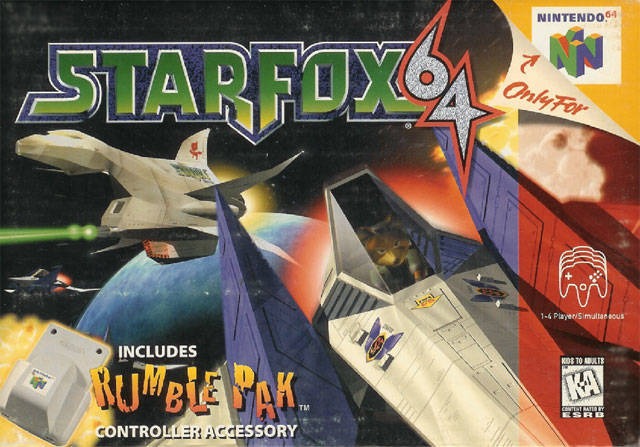
The Rumble Pak, of course, is one feature that probably doesn’t seem all that significant nowadays, at least in regards to one particular game. But being packaged with Star Fox 64 at launch naturally made the game intertwined with the accessory for those who played it at the time. And while vibration and feedback in our controllers has obviously made massive strides in the past few decades, Star Fox 64 definitely deserves credit for being the courier of this feature to the general public, even if Sony would be along shortly thereafter with the first DualShock controller in fall of that same year.

Even accounting for a few levels that are off-world and therefore have similar stars and space backdrops, the visual style and variety in Star Fox 64 is astounding. The way each planet and area brings such a distinct feel to the game is wonderful from the badlands on Titania, to the deep-sea grandeur on Aquas, to even the Earth-like oceans and cities on Corneria, where every playthrough invariably begins. To think that these are the worlds that its predecessor was attempting to convey makes it that much more special, but creating the Lylat System as this comprehensive collection of worlds in an intertwined system, threatened collectively by an invading force is a brilliant success. Andross’ forces that populate each of these levels make up most of the remaining influx of great design. An array of inspired visual design that often ties in with the gameplay, the way they refresh almost entirely in each area is that much more impressive.
And while a lot of the visual design goes a long way to characterize and realize the universe of Star Fox and of the Lylat System as you fight your way through it, it can still barely hold a candle to the sound design. It’s one thing to say that Star Fox 64 has amazing music, of course — it’s just loaded with tension, atmosphere, and grandeur — but with fully voiced characters that chime in and banter throughout the entire game, Star Fox 64 essentially achieves its immortality through sound design and writing. And while that certainly isn’t unheard of, even for the era, it kind of is for the Nintendo 64, and even for Nintendo as a whole, who very rarely utilize so much voiceover even when not opting for the common silent protagonist trope.

We all know about “do a barrel roll” becoming one of the earliest memes, but there are so many individual lines that are so memorable and go a long way to defining all these characters, including not only our main foursome of Fox, Slippy, Peppy, and Falco, but allies like Katt and General Pepper and villains like our big bad Andross, named rivals of the Star Wolf team, and even one-off enemies like the end of level bosses or one-segment antagonists. Major characters become so incredibly endearing and well-defined while also fulfilling their in-game roles, like Peppy chiming in with words of wisdom both game-specific (tips on braking, barrel rolls, etc.) and universal (“never give up, trust your instincts”). The cocky, naive taunting of boss characters that don’t even get proper names (“you’re not as stupid as you look”) contrasted with proper overarching villains, including big bad Andross and his particularly sharp barbs (“you will die, just like your father”) makes just as much of an impact, and it really does feel like this is something that no other N64 game does, and few PlayStation or other games of the era do it in the same way.
As gaming was still slowly transitioning into a medium that could tell stories with voiceover and dialogue, as opposed to schlocky FMV scenes from the early CD era or text-based narratives due to budgetary or technological limitations, the exact way that Star Fox 64 delivers this writing is its number one reason for being so fondly remembered by most players. The gameplay is still addicting and satisfying, yes, and will finally be discussed before my conclusion, but the cultural impact of so many quotable moments and line deliveries is palpable, going back to that vintage meme and including any number of personal favorites from “cocky lil’ freaks” to “stick to the pond, froggy.” Other games like Metal Gear Solid and Resident Evil come to mind for how they delivered consistent dialogue as part of their storytelling, but while the former has its moments of serious emotional storytelling and a consistent narrative, the latter consistently undermines itself into that B-movie territory with corny lines like “Jill sandwich” and “master of unlocking” that became immortalized in early memery but for arguably the wrong reasons. Meanwhile, both of those happen exclusively in cutscenes, whereas Star Fox 64, like its SNES predecessor, incorporates banter into its action, having characters respond to the scripted events of the level to build immersion or even to alert the player to a teammate in danger or objective that needs attention, like a spinning plate about to drop. Only now, of course, it isn’t mandatory to take your eyes off of what’s in front of you to read the transcript of what was formerly Animal Crossing-style gibberish.

Star Fox 64 takes the corridor style shooting that seemed like the natural evolution of the shoot-em-up genre when it debuted on the SNES, and does it faster, tighter, sharper, and with downright inspired variation across a number of levels. Despite always starting on Corneria and ending on Venom, there’s a ton of variety and other reasons to encourage replayability, from various combinations of the five levels in-between your start and end points, to an addicting high score mechanic, to an early achievement system that rewards you with an even greater challenge once you prove your ability to dominate and master each level and its variations. The fairly simple control system with two weapons and a handful of snazzy maneuvers gets used very cleverly across each level, which offer various goals and possible fork points that it would take numerous hour-long playthroughs to see them all, and not just because the campaign itself has a true and false ending. The first time you hit one of the truly special moments like the switches on Macbeth, or even just the Attack Carrier route on Corneria that comes from such an inconspicuous method of playing the game that you might do it by accident your first time, it feels absolutely brilliant and impossibly satisfying.
And that variety, of course, goes beyond just flying your Arwing: two levels involve piloting the Landmaster tank and one puts you in a submarine called the Blue Marine deep below the surface of a world covered in water. This comes largely from ideas brought about in the canceled Star Fox 2, which would have gone a long way in its own gameplay variety, and some of this rolled over into Star Fox 64 with these different level concepts. And while the Blue Marine might be a little slow and awkward compared to the rest of the game, the fact that it’s limited to one mission definitely keeps it from being complaint-worthy. The Landmaster, on the other hand, contributes to quite possibly the best mission in the entire game, Macbeth, where arguably everything Star Fox 64 does so perfectly comes together at once. Chasing behind a massive supply train piloted by a cocky, sinister baboon taunting you the whole way while he tries to knock you off his tail leads to some of the best lines and the most immersive gameplay that the game has to offer, even when the bar is so incredibly high. And if you manage to pull off the alternate ending, sending him careening off the intended track and into what becomes the campaign’s most indulgent fireball before the end, you’ll feel just how satisfying this game gets, Rumble Pak vibration and all.

The Star Fox franchise admittedly doesn’t have a lot of must-play entries. In fact, most will tell you that this is the only real good one. But it is a must play on the N64, on par with Mario, Goldeneye, and Ocarina of Time. The style of gameplay hasn’t held on in the public consciousness, and Nintendo rarely sees fit to try and repackage or reboot it in the style of 64, only to port or remake it mostly as it played in 1997. But that does ensure that it remains accessible and that players should give it at least that one or two playthroughs that only take about two hours of playtime to experience the allure of the Lylat System and the characters that probably don’t get the personification in Super Smash Bros. that they deserve. Star Fox 64 is a nearly perfect game because like a lot of the great, 10 out of 10 brilliant titles of yesteryear, it’s bold, it tries new things, it moves the technology forward. And while it’s not without its hiccups, they only serve to contrast how good the vast majority of the game is. I’ll say it again: it is my favorite game, and a big reason that the site you’re currently visiting exists. Please give it a try if you haven’t before.
Continuing Legacy
Brutal. As a religious follower of this franchise, almost exclusively because of this game, that’s personally how it feels. Because while a remake for the 3DS and availability on any Nintendo console since the Wii keeps its legacy in view, along with more and more characters being introduced to the Super Smash Bros. roster, actual new entries in the franchise have consistently flopped or just generally failed to live up to it. The best game to be released since may very well be Star Fox 2, which officially arrived on the SNES Classic in 2016, even though it was made before Star Fox 64. It’s worth noting that 64 is the only entry which Nintendo EAD has made entirely themselves, often working in tandem with third-party developers such as Platinum Games for the Wii U’s Star Fox Zero and Namco for the GameCube’s Star Fox Assault.
Additional Information
Saves: Cartridge
Compatible With: Rumble Pak
Players: 1-4
Print Guides: Prima, Nintendo Power, BradyGames, Sandwich Islands
Aggregate Critical Reception (GameRankings): 89.87%, based on 14 reviews
Other Releases: JP, April 27, 1997
EU, October 4, 1997, as Lylat Wars
My Streams
Commercials and Print Ads


2 responses to “Star Fox 64”
[…] Star Fox 64 (N64) — From the first time I beat it when I was maybe five, to finally earning my Sector Z medal for hard mode in college, hundreds of runs and the audio, the controls, the bosses, it’s never gotten old for me. […]
[…] Star Fox 64 […]