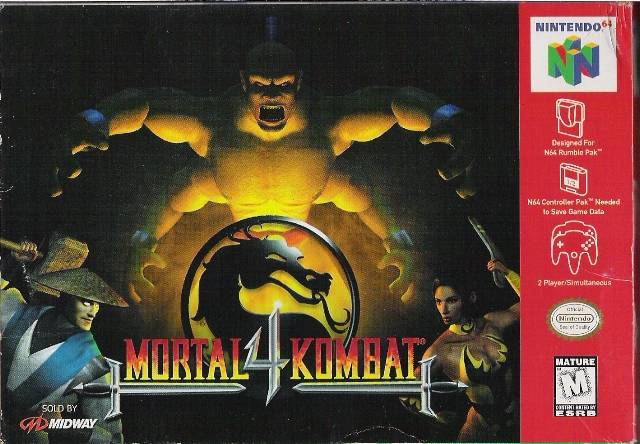
Developer: Midway (Arcade Original) Eurocom (Port) Publisher: Midway
Released: June 23, 1998 Rated: M 6/10
Well, it didn’t kill the series. Mortal Kombat 4 arrived in arcades in 1997. By that point, Ed Boon and Midway had mostly prepped their roadmap of 10 “Dos” and 500 “Don’ts” of 3D Fighting Game development from Midway’s own War Gods, not to mention a plethora of other 3D pioneers that had established footholds while Mortal Kombat 3 was busy going Ultimate. And Mortal Kombat 4’s biggest takeaway on going 3D kind of seemed to be that “you never go full 3D.”

Yes, Mortal Kombat 4 has 3D visuals (for better or worse) and a sidestep mechanic to dodge to the foreground or background. But this is basically a 2D game that feels very much in line with the existing gameplay of the franchise and the early era of the genre. If nothing else, this creates cleaner gameplay more like what one would expect, even more so nowadays, from a “3D Mortal Kombat” rather than a “full 3D arena fighter,” which we now understand to be a completely different genre that doesn’t operate on the foundation of combatants sharing a common plane at all times.

While this unfortunately doesn’t make for a Mortal Kombat title that’s revamped the series or would really be any fan’s favorite entry, it does make for a solid fighting game once it hits the N64, a series deprived of most of the era’s finest in the genre, and a familiar yet slowly evolving MK title. Keeping in mind that the first decade of Mortal Kombat is largely accepted as being more about spectacle than well-rounded gameplay, MK4 feels familiar and befitting of that initial run, with a few new mechanics and visual style to inch things forward, whereas its main failings actually come from its lack of contribution to the series’ ongoing legacy and identity. In short: the characters are getting lamer, but you can pull out a big axe or hammer and batter your opponent whenever you want, so that’s pretty cool.

One of the biggest ways this classic MK era is remembered is the impact on the series roster and assortment of other assets. MKII added nothing but iconic characters and arenas to the catalog, while MK3 had its hits and misses (looking at you, Stryker). MK4 meanwhile… is not good on this front. Of the characters introduced here — Fujin, Jak, Kai, Reiko, Tanya, Shinnok, Quan Chi, and the joke character Meat, the impact is minimal. Tanya is far from the worst, but most of that list is made up of fighters that most would consider, well, dorks. Even worse if you take out the three who were introduced to the series mythos in Mortal Kombat: Mythologies — Sub-Zero, and are merely playable for the first time here; Fujin, Quan Chi, and Shinnok were all key figures in that story, leaving the rest of these guys to pretty much stink up the place and maybe come back for a nice on screen death down the line.

More egregious, even, is actually the way that existing characters are probably the worst sufferers of the 3D transition with some of their new designs. While there are some pretty great weapons getting associated with guys like Raiden and Jade that would stick, putting Scorpion in a dark blue outfit is one of those designs that would take about 20 years to get any love through ironic nostalgia and improved rendering. Same with Reptile, who gets his first chance to break free from the palette-swap ninja outfit, but looks absolutely ghastly in this iteration with his still far too humanoid base model.
Thankfully, the character models themselves are probably the worst visual element here, as animations are decent, at least not being too jerky or unnatural like some other titles around this time. And arena design is really strong here, with lots more moving elements than in War Gods, for example, and other generally much better ways of making Mortal Kombat’s level design look really grand, imposing, and appropriately detailed. Screaming walls in the Elder Gods’ Arena and roaring furnaces in the Fire Well look great and have similar eye-catching flair on top of the skulls and other debris littered across them.

MK4 moves the series along at a reasonable pace, entering the 3D space without selling out on a total revamp to serve the advancing technology. It’s an entry in the franchise from the classic era, albeit very likely the worst one of the time and unable to offer what even Mortal Kombat Trilogy does in hindsight — an expansive roster for the time and visuals that evoke proper nostalgia for the era. It certainly is an oddity, though, and important to play for fans of the series for how different it is from the various MK3 iterations and the following generation’s trio of Mortal Kombat titles. It will scratch your itch for the series on the N64 just fine, but it doesn’t give you the best overall fighting game experience on the console.
Continuing Legacy
The presence of Shinnok, the fallen elder god, and his servant Quan-Chi as the main antagonists of the story would create a large impact on overall series continuity going forward, though a lot of their story actually happened in MK: Mythologies – Sub-Zero and was followed up here. A few key character design elements did originate here, though, like iconic weaponry and costuming developments for established characters. This entry also stripped a lot of the overly silly elements that had crept in largely in the MK3 era, resetting the series course in a more serious and violent direction going forward.
Additional Information
Saves: Controller Pak
Players: 1-2
Compatible With: Rumble Pak
Print Guides: Prima, BradyGames, Tips & Tricks Magazine
Aggregate Critical Reception (GameRankings): 77.31%, based on 18 reviews
Other Releases: EU, September 15, 1998
My Streams
Commercials and Print Ads

Gallery