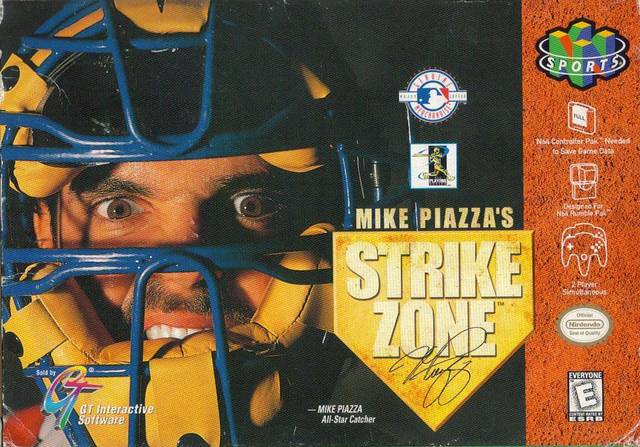
Developer: Devil’s Thumb Entertainment Publisher: GT Interactive
Released: June 16, 1998 Rated: E 3/10
Released too late to even snag the coveted “first to market” title stateside, Mike Piazza’s Strike Zone does at least one thing right: it reminds us of a time when any old publisher could snag a professional sports license and release an actual attempt at competing with the rest of the market. I admit, I tend to put a little too much stock into the benefits of this bygone era, and getting Mike Piazza’s Strike Zone out of the deal doesn’t exactly put a lot of shine on it either, but a fully licensed MLB title from GT Interactive of all companies is something of an anomaly that I’d like to express some appreciation for. Too bad Strike Zone is pretty much the N64’s worst North American baseball game.

There’s a little known release in the Bases Loaded franchise from the early days of the original PlayStation, Bases Loaded ‘96: Double Header, that I consider to be one of the worst baseball titles I’ve ever played, in part due to the fact that it’s so incredibly dated for even a first-year release on the PS1. Mike Piazza’s Strike Zone comes in just under the N64’s second birthday, and still exemplifies this same problem. Low detail textures, faceless and indistinguishable player models, and hilariously low frame rate animations make Strike Zone look embarrassingly unpolished and downright ugly. All-Star Baseball and Ken Griffey Jr. aren’t the only games setting the standard here, either, as Japan had been getting their own baseball titles since the early days of the system, and each has either a distinct visual style or at least offers a crisper visual presentation.

Even if you can look past the visuals, however, this is still a title that doesn’t seem up to par for the hardware it’s on, or at the very least suffers from some pretty archaic gameplay choices. For a game that claims to offer an authentic simulation mode as well as a fast-paced arcade style, it’s pretty baffling to see that no matter which you choose, homers are consistently getting knocked 600-plus feet, pitchers are scorching mitts with 105 mph fastballs, and fielders are blooper-reel colliding with the outfield wall any time you get close to it.

The basic interaction between pitchers and batters is pretty quick to reveal how undercooked the gameplay is even in a strictly fast-paced approach. Though pitchers do have a good selection of pitches that are conveyed well visually and in timing, the philosophy of control lacks any nuance whatsoever. I’ve literally never seen a baseball game opt for the segmented strike zone and have only one out of nine zones be a strike while the rest are balls. And this is made even worse by how the batter is able to gauge each pitch by the trail coming off of it from the pitcher’s hand: a red trail is a strike, a blue trail is a ball. Simple as that, and honestly laughable for a game attempting to progress anywhere past the previous era that offered top-tier experiences with incredibly precise simulations like World Series Baseball and lower-autonomy arcade-style titles like Ken Griffey Jr Presents Major League Baseball.
Though Strike Zone did manage to offer one distinct advantage over its competitors at the time, with player-created team options and lots of other roster management features, its gameplay and presentation are pitiful and I can’t imagine them being worth the sacrifice. Although neither All-Star Baseball ‘99 nor Ken Griffey Jr. offered much by way of commentary or in-game audio design, Strike Zone doesn’t either, with only a few repetitive voice lines that play for each example of an in-game event like a run scoring or a strikeout. Add in pitiful animation quality and player models that even the PS1 and Saturn could easily outshine by this point on lesser hardware and Strike Zone sits well within the bottom tier of a system that offers a lot of baseball titles, good and bad, across both North American and Japanese releases.
Continuing Legacy
Sadly, Devil’s Thumb Entertainment would not make another game, with their only other project, Hired Guns, being cancelled before release. While Strike Zone does not offer much in terms of influence, cover star Mike Piazza was elected to the Baseball Hall of Fame in 2016 and is considered one of the greatest hitting catchers in baseball history. By the time this game was released, he had already left the Los Angeles Dodgers, having joined the New York Mets after a brief stop in Florida, where he would have the longest stint of his career.
Additional Information
Saves: Controller Pak
Players: 1-2
Compatible With: Rumble Pak
Print Guides: None
Aggregate Critical Reception (GameRankings): 36.00%, based on 3 reviews
Other Releases: None
My Streams
Commercials and Print Ads

Gallery