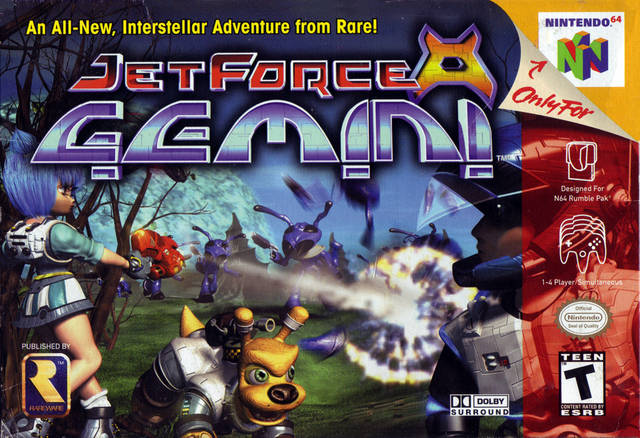
Developer: Rare, Ltd. Publisher: Nintendo
Released: October 11, 1999 Rated: T 7/10
Jet Force Gemini occupies quite possibly the most unique position in Rare’s extensive legacy on the N64. Not beholden to a larger, multi-game franchise like Banjo, not a game which utilizes another company’s IP or characters, like Donkey Kong, and not separately praised or remembered for other reasons, like the unique crassness of Conker. Jet Force Gemini is one of Rare’s boldest efforts on the system going simply by its scope and grandeur, a massive, planet-hopping adventure that combines elements from its collect-a-thon platformers and mission-based level design and frantic multiplayer from Goldeneye 007.
Polished to a fine sheen with striking visual design and an audio tour de force in its soundtrack, and Jet Force Gemini has everything going for it to be one of the N64’s most fondly remembered original titles. But while it certainly delivers to some degree on all of these fronts, the combination of shifting sensibilities in the years since its release and a little bit of overambition upon its arrival make Jet Force Gemini something more akin to a second or third-tier cult classic that shirks off newcomers and those not dialed in as closely to the late-’90s mindset, and not a must-play all star on the level of other Rareware titles. The adventure of the titular Jet Force Gemini, composed of twins Juno and Vela, as well as their dog Lupus who is every bit as capable of waging war against the villainous Mizar and his drones, takes players across 15 worlds and several divided stages within each. While any of the three characters can be used on each stage, skills unique to each character will be necessary to advance past certain points on a regular basis, meaning that using the right character at the right time is a crucial choice – and that you can’t just be the dog the entire time, sadly. This makes up something of a Metroid Prime-esque setup, where returning to different areas at different times is necessary to accomplish all tasks in various increments of play time. Individual stages and areas will have requirements to advance, like defeating all of the enemies or activating a switch, but your ultimate goal in Jet Force Gemini is to acquire 12 ship parts and save all 282 Tribals – a race of small, koala bear-esque creatures – before being allowed to progress to the final encounter against Mizar.

Before continuing any further, I will just reiterate that last fact, so as to highlight one of the key frustrations most players will have with Jet Force Gemini, which is that to finish this game – not 100% or complete it, but just to roll the credits – you must collect all 282 of the primary collectible. Aside from the fact that, as these are living creatures, they can actually be killed by enemies or friendly fire before you reach them, causing you to have to replay an area to rescue them, this highlights that Jet Force Gemini really doesn’t have a lot of respect for the player’s time. I’ve said this before, and admittedly it’s one of the biggest gray areas and “your mileage may vary” concepts in retro gaming – determining the line between padding and content, or giving value for money versus putting you through a slog – and I think that Jet Force Gemini is the truest sense of this issue in what is still an overall good game. Jet Force Gemini is a fun game, but the grind that you will have to put in the first time you play it has a good chance to make you put it down, not pick it back up, and/or never want to play it again even if you do manage to finish it.
You can tell that that scope is 100% intentional, however, by the nature of Jet Force Gemini’s presentation, which is why it’s hard to outright fault the game for dancing so recklessly around the line between expansive and bloated. If Tim Stamper and his team from Rare knew one thing, they were going for a true space epic in Jet Force Gemini, and they did achieve that in both design and technological achievement. It’s odd that while the campaign’s layout is so hampered by a modern lens, Rare future-proofed Jet Force Gemini to a degree with a bold, theatrical mentality in the sound and graphics. While they were developing Donkey Kong 64 at the same time with widescreen and Dolby Surround support, and would be able to implement these features in a few more releases on the system, Jet Force Gemini is the first N64 title to offer these features. Even without surround, however, Robin Beanland’s epic soundtrack hits like a sledgehammer as soon as the main menu pops up, continuing a Rare trend of exceptional sound design and music composition that, while not as memorable on a track-by-track basis as the more playful tunes in Donkey Kong or Banjo-Kazooie, really highlight the high standard of the company while working on a system that so often defaulted to cheap MIDI sound quality even on equally well-composed tracks.

A lot of work clearly went into the variety of environments and setpieces in the game as well, with levels spanning lush jungles to cold, Alien-esque space stations, to volcanoes and caves and more. Textures and environments are really pretty and varied along the way, though by comparison, the models of enemies and NPCs look surprisingly awkward. This is true compared both to other Rare titles and to models like the main characters and bosses. The Tribals and the grunts you spend the most time fighting probably get this the worst, particularly with their stiff animation, though it is cool when these big blocky bipedal ants explode into a rain of individual body parts to be collected like trophies alongside ammo and health pickups. If that sounds surprisingly violent, you’re quite correct, because even that T rating or the slightly more serious tone of Jet Force Gemini does not prepare you for the raised standard of violence here. You’ll obviously get used to it over the length of the campaign, but it’s kind of a surprise every time you start playing it, whether it’s been a day or a year since the last time you’ve done so.

The controls will probably also take some getting used to every time you play again, too. The most objectively weak area of Jet Force Gemini, it’s tough to determine if the genre or the platform provides the biggest hurdle in making the controls feel natural. A better lock-on system could have helped, or a little less focus on taking down waves of enemies all at once, but a lot of firefights end up feeling a lot like trying to wrestle down a spraying fire hose. One on one shootouts with a strong enemy are a little bit easier to settle down, but the constant encounters of as many as a dozen moving drones or grunts at a time lead to a lot of spray-and-pray strategy that doesn’t feel great. Having a lot of the platforming and exploration feel good when things are settled down, even if it is a bit slippery with your characters’ momentum, does benefit the average, but it’s another area that probably never felt great, but is the other main problem that will weed out those not fully prepared for the ups and downs of the adventure.

Jet Force Gemini was a big undertaking for Rare and remains an equally large project for modern players. Those looking to explore the resume of the N64’s secondary saints should still see it as a must-play, but anyone can be forgiven for not jiving with it after a few hours. Its scope, grandeur, and ambition should be experienced, even if out of context such as sampling the OST or trying some of the unique multiplayer modes like the racing game or other splitscreen interpretations of the main gameplay, where the frantic nature can become a boon to the experience.
Continuing Legacy
Surprisingly lacking in its influence or impact on future titles from Rare, Jet Force Gemini’s modest sales compared to others from the company around this time. Still accessible via Rare Replay and Nintendo Switch Online, thankfully, it’s not hidden away or strictly for original hardware enthusiasts. Though it isn’t necessarily responsible for enabling it, only a handful of other iconic titles would utilize Dolby Surround over the last 18 months of the N64’s run, including Donkey Kong 64, Banjo-Tooie, Conker’s Bad Fur Day, Perfect Dark, and The Legend of Zelda: Majora’s Mask.
Additional Information
Saves: Cartridge
Players: 1-4
Compatible With: Rumble Pak
Print Guides: Prima, BradyGames, N64 Magazine
Aggregate Critical Reception (GameRankings): 79.13%, based on 23 reviews
Other Releases: EU, October 29, 1999
AU, 1999
JP, December 1, 1999, as Star Twins
My Streams
Commercials and Print Ads


Gallery