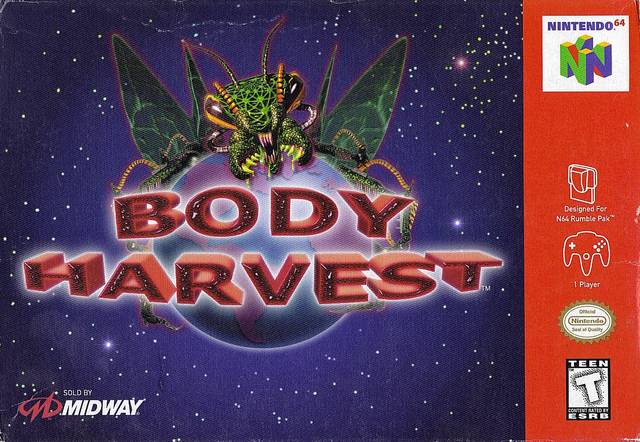
Developer: DMA Design Publisher: Midway
Released: October 20, 1998 Rated: T 6/10
With the late ‘90s being the boom period of media about fighting alien space bugs, the N64 proved to be no slouch in this department — in spite of all of the other trends it failed to meet. And while top-tier established developer Rare put their own signature expansive spin on the flavor with Jet Force Gemini, and Acclaim attempted to use the Turok engine again for another of their new Valiant comics franchises in Armorines: Project S.W.A.R.M., the early previews of the Nintendo 64 were rife with concepts from DMA Design, an early member of their dream team of developers for the system, one of which was an anticipated launch title for the system called Body Harvest.
Eventually releasing (checks notes) over two years, several project cancellations, and two partnerships with publishers later, Body Harvest hit shelves in Fall of 1998 published by DMA’s short-lived owners, Gremlin Interactive, in Europe, and Midway in North America to finally deliver on an otherwise assumed dead release. It received little marketing and fanfare, as did DMA’s other late 1998 N64 title, Space Station Silicon Valley, and the fortunes of the company would seem to be continuously on the downslope. Oh, except they had this one project, Grand Theft Auto, that they started working on around this time, and that did pretty well for them.

Yes, Body Harvest began as the flagship product of a developer seemingly about to strike it big with investments from the big N, only for the game itself to stumble repeatedly and eventually lose all the spotlight and attention of the company and the public in the wake of the beginning of the global phenomenon we know today. But Body Harvest still boasts plenty of reasons to give it a try nowadays, even if the final product certainly comes off as unpolished, unfinished, or overly ambitious for the hardware in the form we have it. The DNA of, well, DMA and its forthcoming successes is actually ingrained into Body Harvest in its focus on open-world exploration, the ability to interact with as many in-game objects as possible, and unique mission objectives, all of which impart an overarching sense of freedom in the player to tackle the game’s story and individual sections at their own pace.
You can certainly get a sense of Body Harvest’s scope from the start, as your first mission brings protagonist Adam Drake back to 1910s Greece to combat the earliest bout of the alien invasion that occurs every quarter century. Arriving amongst sparsely populated villages in the rocky coastal hillsides, Adam searches out alien activity and combats while commandeering various period-appropriate vehicles and weapons, interacting with townsfolk and staying on alert for troubles as they arise during his mission. With each individual level taking place over about a quarter of each map, the size of the maps is quite impressive for the era. Of course, when there’s really only so much to see and a lot of empty space in between them, it does take away from the scope. Even when in key areas with lots of buildings, people, or other landmarks, it’s obvious where technical and labor constraints shut down a lot of best laid plans.

DMA does put their best foot forward in designing for freedom and variety in Body Harvest, hence why it’s such a clear representative of their overall company philosophy as they’ve gone on to achieve with Grand Theft Auto and Red Dead. It’s unfortunate that the developers clearly want you to be able to talk to anyone or go anywhere they put in front of you, but it’s just not feasible on the hardware, I’m sure, and even more hampered without the full focus of the team by the time it was finished. It would be great if, say, every building had at least one room you could see if you walked through the door, even if there was nothing particularly special in there. Instead, about 75% of them are boarded up. At least there are vehicles everywhere, all drivable unless blocked off for mission purposes. And only physics are keeping you from going up, down and around most of the map, or at least the section your current mission takes place in.
Even in more core gameplay areas, Body Harvest does resemble a primitive 3D Grand Theft Auto several years before GTA3 and alongside the first two games. Although fighting bugs would appear to be the game’s key gameplay element, it’s much more about driving, exploration, and a big scavenger hunt, for lack of a better term. Talking to an eclectic mix of NPCs to gather info, add to your arsenal, or open the way to the next area is what Body Harvest is mostly all about, with some gunplay or vehicle combat to keep you on your toes even if it’s not mechanically all that deep or polished.

Body Harvest is a fun romp and an even more interesting piece of history for one of gaming’s biggest juggernauts. With GTA becoming such a phenomenon and a blueprint for so much of the gaming market in the 2000s, seeing something so closely resembling it beforehand is a trip, to say the least. It’s by no means a bad game, but it’s also far too unpolished and somewhat unfinished to be anything more than a decent adventure and curiosity play. Regardless of how you might feel about the pacing and layout of it, the similar Jet Force Gemini is almost certainly the better game, but only Body Harvest will let you have anything close to the sandbox experience it lays down the foundation for here.
Continuing Legacy
Rockstar North neè DMA Design is, for better or worse, a cornerstone developer and publishing label of the gaming industry in the mid-2020s, currently poised to shatter every sales record upon the release of Grand Theft Auto VI, even though it will not have a physical copy on release and cost 79.99 USD.
Additional Information
Saves: Cartridge
Players: 1
Compatible With: Rumble Pak
Print Guides: Prima
Aggregate Critical Reception (GameRankings): 76.68%, based on 14 reviews
Other Releases: EU, November 13, 1998
My Streams
Commercials and Print Ads


Gallery