Composer: Koji Kondo
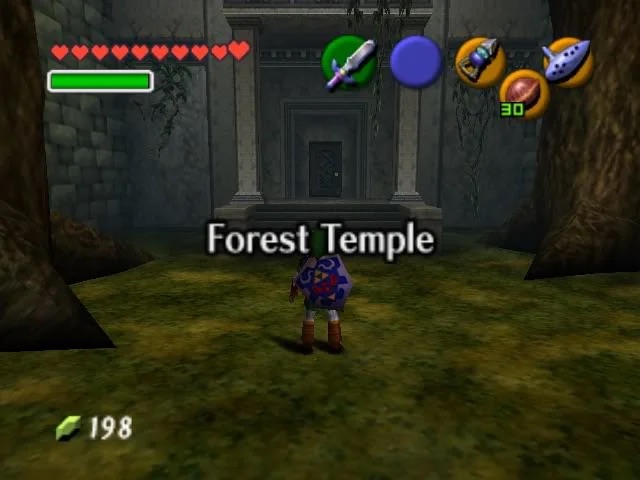
After the three dungeons of the child era opt collectively for more of a tonal approach in their background music, the first temple we tackle as adult Link opts for not only a truer melody-forward composition, but a truly unique piece of music that captures everything its location stands for without either one defaulting to what you’d most expect from a level set deep and secluded beyond several layers of forestry and druidic magic. Getting there brings us back to the Sacred Grove, a place where we forged our last memory with Saria and learned the song that most ties us back to this realm of our childhood. And at the heart of this seemingly-untouched deepwoods sanctuary is where we find something less like the inside of the Deku Tree and more of a lived-in manor house.
As the sprawling vines and grasping branches grow unencumbered through the halls and corridors of the Forest Temple, slowly reclaiming their hold on the land itself, the sense of history and generations past practically oozes through the seams in the brick and stonework. And what are its inhabitants alongside the deku babas that have taken root in the atrium and the skulltulas that weave their webs over portraits of residents long-deceased? Ghosts – a family of Poe sisters, flying skulls wrapped in ethereal blue flame, wallmasters that are more concerned with casting you out than truly hurting you, undead Stalfos, and, as even our enemy displays his penchant for thematic consistency, an incorporeal puppet of himself known as Phantom Ganon. This is a haunted house, and one that through its twisting corridors and shifting orientation of entire rooms, seems to take inspiration from a real life haunted house – the Winchester Mystery House, itself designed to trick and confuse spirits through its labyrinthine construction. But unlike the ominous and decrepit tombs such as Twilight Princess’ Arbiter’s Grounds or Ocarina of Time’s own Shadow Temple, the Forest Temple is not a monument to horrors of the past, but a nest of memories, something that Link himself is in a unique position to face upon exiting his seven-year sleep.

The use of reverb and echo in several areas of the orchestration for the Forest Temple music is the first of many ways Koji Kondo plays on the feelings of memory and the fleeting nature of a given moment. Forest Temple plays tricks on you from the opening strike of percussion that not only echoes back upon itself with each note played, but bounces between each side of the stereo playback as it does so. What’s more, that ticking clock sense of percussion tricks you into thinking that it will allow you to pin down the primary source of the song’s meter. This instead comes from the same place that we take the most forward source of melody, that being the blended line of the strings and, of all things, the vocal samples of Link himself. A rhythmic pitter patter that sounds almost like Link jumping his way across Hyrule Field, but between the way it morphs between the staccato strings and Link’s grunts, it’s very hard to pin down the timbre of yourself to replay in your head with proper transitions. Even more so is to try and sing it yourself, with the sampling and dressing up of Link’s voice so difficult to recreate, simply because you’re not him.

This is where we end up with the Forest Temple music, though, via any angle we approach it: we simply can’t pin it down, we can hardly get a beat on it no matter how hard we try. It’s like the aural equivalent of floaters in your eye: you can see them right over in the corner of your vision, but as soon as you turn to focus on them, they’re off in another direction, they slip through your fingers like so many grains of sand, plain to observe yet impossible to grasp. Such are Link’s memories, such are our own. Ghosts on the edge of our perception, reminding us they’re there, yet completely intangible when we turn our attention to focus on them.

We can play a remake of a game we know like the back of our hands, a thing that we knew looked and felt and sounded just like this new version did decades ago. There is a version of that adventure that previously existed in our memories that’s just like this one, but the tragedy of it, no matter how much it resembles the version we saw in our minds, is that it isn’t what we remember. And to try and chase the feeling we got when we played those games will always be us chasing that intangible thing at the back of our minds, in the depths of our dreams, or among all the layers of din that obscure the melody of a beautiful song. It is us, exploring the Forest Temple, a vault that encloses the memories of things long past, but never forgotten.