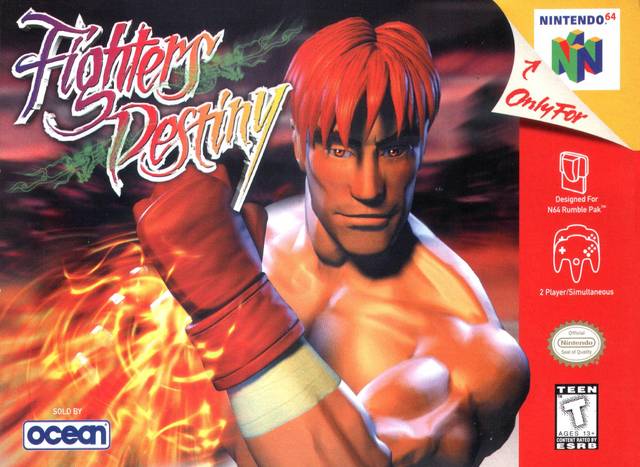
Developer: Opus Corp, Anchor Inc. Publisher: Ocean
Released: January 26, 1998 Rated: T 7/10
When the N64’s genre shortcomings are listed off, we often hear about the RPGs (taken away by Square, Capcom, and to a degree, Enix) and the fighting games (again, Capcom, why must you forsake us so?). And while the RPGs are just absent completely, the state of fighting games in the N64 library is almost worse – there are a lot, there’s just so many bad ones. And when they’re good? Well, you’ve either got titles with name recognition who are going through some… things… like Mortal Kombat 4. You have some solid early 2D titles like Killer Instinct Gold and Mortal Kombat Trilogy, except that those were arguably aged at launch compared to Virtua Fighter and Tekken on other consoles, despite their staying power. And then there are a few gems; well, maybe gems isn’t the right word. Because while it’s not particularly sexy, flashy, or inventive, Fighters Destiny is a lovely little underdog of a fighter that may not stand up to the Playstation’s best in the realm of 3D fighting games, but does its damnedest to be there for you to get your fix of such titles on an N64 cartridge.

Fighters Destiny certainly doesn’t reinvent the wheel, the printing press, or the concept of sliced bread in its premise or its roster, the latter of which is made up almost entirely of archetypes familiar to any fighting game aficionado. These include the standard gi-wearing martial artist featured on the cover, the ninja, the wrestler, the boxer, etc. Where it almost certainly sticks in your brain, if you’ve ever played it before, even for a round or two, is that it operates on a scoring system somewhat inspired by more traditional fighting tournaments. Instead of just trying to get your opponent’s health bar to zero first, points will be awarded and action stopped after any number of events in the game. This ranges from a single point for a ring out, two for a successful throw, three for a knockdown (which can happen from certain moves or from reaching zero HP), three for a successful counter, and four for landing a special move. One point will also be awarded by judge’s decision if the timer runs out on the action before any of these things occur.

With seven points winning a bout, and several ways to accumulate them, it adds a lot of extra strategy to how you might approach playing the game. It’s not a groundbreaking or completely revolutionary mechanic by any means, but it’s one of the few ways where Fighters Destiny goes beyond just being a really solid framework of a fighter, with the other being the Master Challenge mode. Adding a little bit of a board game/slot machine element to proceedings, the Master Challenge is a way to unlock additional moves for each character by winning individual bouts against a character called The Master, winning the challenge when you’ve beaten him eight times and unlocked all the hidden moves. The slot machine comes into play in that you have a two-thirds chance of facing The Master in your next fight, and a one-third chance of facing The Joker, who will take away all the moves you’ve earned so far if you lose – winning gets you nothing, you just don’t lose your progress. Funny joke, thank you. If fighting game Russian Roulette isn’t your thing, even if it’s a fun idea that does well to shake things up, there are also traditional arcade, survival, training, and time attack modes, plus a mode called Rodeo Mode where the player simply tries to stay alive against a cow character called Ushi – a far more eccentric character than any of the standard characters or even The Joker.

These are all good ways to cut your teeth on the existing movesets and feel of the game overall, which is done very well considering it limits the attack buttons to only the A and B buttons of the N64 controller, instead of the full complement of face buttons. The result is something that is easy to fudge your way through when picking it up for the first time, as you only use the two buttons your thumb is most drawn to anyway, but appropriately difficult to master, even while adding moves to your arsenal at a more gradual pace. If nothing else, Fighters Destiny proves through its control scheme alone that it sought to fill a gap in the young system’s library as much as anything, and it certainly does that in an otherwise unassuming manner that manages to come off as charming and respectable in the long run, and I really enjoy that about it.
Continuing Legacy
While there isn’t much legacy stemming from Fighters Destiny in particular, games of its style, particularly those it takes a lot of inspiration or outright nicks some design details from include Tekken, Virtua Fighter, and Dead or Alive, all of which have had many sequels since the late ‘90s and are still going strong.
Additional Information
Saves: Controller Pak
Players: 1-2
Compatible With: Rumble Pak
Print Guides: N64 Magazine (UK, double guide with Snowboard Kids)
Aggregate Critical Reception (GameRankings): 76.52%, based on 12 reviews
Other Releases: EU, March 1, 1998
JP, December 11, 1998, as Fighting Cup
My Streams
Commercials and Print Ads

Gallery