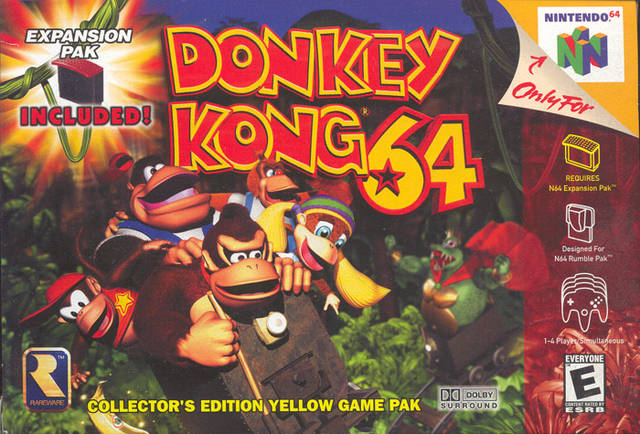
Developer: Rare, Ltd. Publisher: Nintendo
Released: November 22, 1999 Rated: E 8/10
“The bloat, the bloat, the bloat.” I’ve never seen a game’s public perception change over the years the way I have with Donkey Kong 64. As a kid, it was as highly-regarded as any of Rare’s 3D platformers, including those starring a beloved bear and bird. Growing up, the explosion of online discourse and video essays that make up so much of my own retro gaming consumption and information feed arrived at a new consensus: Donkey Kong 64 is a bloated, overambitious mess that embodies the risks of “doing too much.” Too many items, too many characters, too many moves, too many mini-games, way too much to do overall and an absolute monstrosity if you’re a completionist. Playing it enough to roll credits, however, especially with it being made available once again for only the second time since its original release in 1999 (it was released on Virtual Console but not until 2015, on the Wii U), I think the backlash has softened just a little bit, though this may be due to a number of factors. In any case, Donkey Kong 64 may very well be the poster child for the swinging pendulum of public opinion and how any divisive game can have its reputation constantly be in flux as opinions are formed and put to the test; expectations are established and proven or disproven as they are put to the test; a game does most of what it wants to do, and the people playing it have to decide if it’s what they actually want from it at the time they actually play it themselves.

Now, Donkey Kong 64 certainly had its struggles before even getting out of the starting block, and those issues are worth addressing. Or maybe they’re not – as many might be aware, DK64 is one of the only N64 titles that will not function in any capacity without the Expansion Pak and it’s 4MB of additional RAM. Stories have floated back and forth over the years now about why this was the case, with conflicting reports from different development team members concerning an 11th hour bug that crashed the game, while the additional RAM seemingly staved off the issue. Either that, or it was always intended to be mandatory for graphical features like a dynamic lighting system. Whether the accessory was bundled with the game to save Nintendo’s biggest holiday release, or simply another case of the ambitious developers that tried to make the “Stop ‘n’ Swop” system happen may never be confirmed, but in any case, you won’t be playing this game on original hardware with no Expansion Pak installed.

What that extra RAM and other hardware under the hood opens you up to is a fairly large, open overworld not too dissimilar from Grunty’s Lair without the roof covering. DK Isle, besieged by King K. Rool’s floating fortress, features all sorts of nooks and crannies, cliffs and crevasses, plus a few other outlying islands covering the game’s various levels and other characters to interact with, such as the encaged, Godzilla-sized Kremling, K. Lumsy, whom you must free by defeating each level’s boss to earn a key and undo the locks on his cage so he can open up the game’s final fight. Everything in Donkey Kong 64 has this type of multi-stage, Rube Goldberg-type of process that involves playing through the game, collecting various types of items, unlocking new doors through application of all sorts of combinations of moves and abilities. When you break down even a single process into its multiple steps over the course of the game, it seems downright baffling and on the verge of lunacy, even though it’s largely in keeping with Rare’s typical approach to game design. Getting to see how little things you do add up and pay off like a bunch of Chekov’s guns means that for as staggering as the number of items in the game may seem, there aren’t any truly useless ones, and an overly-streamlined version of the Donkey Kong 64 might not be anywhere near as interesting as a result, but overall it can be a truly daunting undertaking to play Donkey Kong 64, where even the gameplay of just one of the game’s five characters matches the content of other collect-a-thon platformers of the time.
Those five characters – Donkey Kong, Diddy Kong, Tiny Kong, Lanky Kong, and Chunky Kong – do essentially constitute the root gameplay mechanic off of which the accused bloat occurs. While each character does have their own gameplay style and moveset, it’s the fact that they also each have their own set of collectibles in each area that must be gathered only by them that raises things into the realm of tedium. While the characters themselves, including the slow and strong Chunky, the size-shifting Tiny, and the acrobatic Lanky are loaded with charm, and their fade into obscurity is extremely disappointing, it’s that they each have their own collectibles including, in each level, five golden bananas for their individual missions, 100 colored bananas that contribute to unlocking the boss door, colored banana coins for earning new moves, a blueprint dropped by an enemy that identifies which color it has by the shockwave it produces (which can be redeemed for one of your five golden bananas in each level). In addition, there is ammo for each character’s weapon, headphones for their instrument power-up, crystal coconut for another special ability, and film for a camera that is used to take pictures of fairies when you see them around. It really is a lot, and it’s exacerbated by the fact that this is not a hot-swap system that can change characters on the spot – you must return to a character-change barrel at various points in the level to change Kongs.

It’s not difficult to see why this game has gotten a reputation for being overly ambitious, bloated, and tedious. And if this wasn’t enough, the fact that you can’t finish the game without a few additional small tasks including a high-score challenge on the original Donkey Kong arcade game and Rare’s classic ZX Spectrum title, Jetpac seem like little extra over-tightenings of the screws. Add in the number of golden bananas that are won via little mini-games and combat challenges and the adventure does seem to go pretty much all over the place. But again, it’s not that far outside of Rare’s usual approach, it’s just a bit bigger and, in hindsight, makes Banjo-Kazooie in particular feel like the exact sweet spot for this type of game, at least out of the company’s highly-touted library.
I think Donkey Kong 64’s real legacy is the difference between the whole and the sum of its parts. No individual part of DK64 is bad. It has excellent presentation, great level design (even if there’s a little bit too much “dark and creepy” in its theming), tight controls, lovely and unique music and sound design, and boatloads of charm that starts from the opening record scratches of the DK Rap. But at some point, people’s perception of the genre reached a point (and online discourse reinforced that perception) that focused more on why gaming moved away from the collect-a-thon platformer, before eventually circling back to why people enjoy it so much. The point of exhaustion may differ wildly over the course of a playthrough, but at over a quarter-century removed from its debut, Donkey Kong 64 is a strong example of a collect-a-thon platformer that only so many people will have the patience to finish, some may only play for an hour, and some may only want to play for its multiplayer and bypass the collect-a-thon aspect entirely. Your mileage will vary, but it won’t be an experience you’ll forget.
Continuing Legacy
With no direct sequel, no re-release or remake, and no other official way to access Donkey Kong 64 until June 2026, the game’s continuing legacy has been determined by retro enthusiasts, leading to the thesis of this post and the game’s status as a focal point when discussing the collect-a-thon genre. Donkey Kong himself has had a few distinct eras since the N64, beginning with a move to the rhythm genre as the face of Taiko no Tatsujin crossover Donkey Konga, a 2D puzzle series in Mario vs. Donkey Kong, and an acclaimed pair of side-scrollers by Retro Studios as a revival of the Donkey Kong Country Series. 2025 saw Donkey Kong return to the 3D platformer style with Donkey Kong Bananza on the Switch 2, another well-received adventure, though it focuses solely on a newly-rebooted DK as your playable character – the Rare design from the original Donkey Kong Country having persisted long after the split from Nintendo.
Additional Information
Saves: Cartridge
Players: 1-4
Compatible With: Expansion Pak (Required), Rumble Pak
Print Guides: Nintendo Power, Prima, BradyGames, Sandwich Islands, GamePro, Versus Books
Aggregate Critical Reception (GameRankings): 87.71%, based on 25 reviews
Other Releases: EU, December 6, 1999
JP, December 10, 1999
AU, 2000
South America, 2000
My Streams
Commercials and Print Ads


Gallery