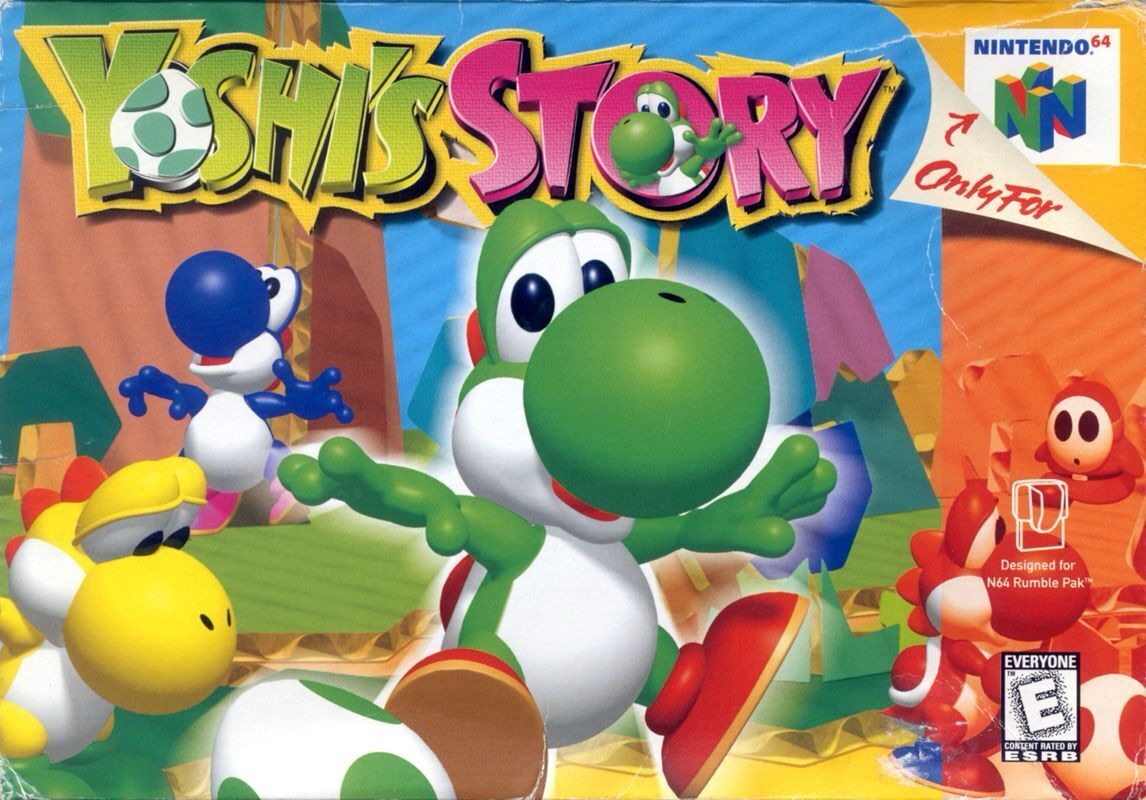
Developer: Nintendo EAD Publisher: Nintendo
Released: March 10, 1998 Rated: E 7/10
Somewhere way down on the totem pole of Nintendo’s platforming franchises sits the Yoshi series. While the character/species is beloved and integral to Mario games, both mainline and spinoffs, Yoshi’s starring roles have been spent working off of the touchstone release of Yoshi’s Island on Super Nintendo, but have also carried some other inherent baggage that limits its overall appeal. Sticking exclusively to side-scrolling, Yoshi platformers have become synonymous with forgiving, simplistic platforming that innovates much more in its presentation than in mechanics. And while this is a perfectly valid role to fill in a company like Nintendo that has, frankly, more franchises than it often knows what to do with, it does temper expectations on what players can expect from the franchise, just as Nintendo themselves can probably do the same for sales figures relative to some other characters.
Of course, Yoshi’s Story does have the distinction of being the first follow-up to Super Mario World 2: Yoshi’s Island, and so it carried with it, at least at the time, some level of expectations different from what the last handful of Yoshi titles might have faced upon release. Add in the fact that the N64 had already seen massive leaps forward in style and technological capability from the likes of Mario, Star Fox, and Mario Kart compared to their respective SNES entries, and Yoshi’s Story does seem to set the bar a little lower by comparison with a 2D platformer that shares a lot of the same moves and mechanics with its predecessor. The Yoshis, free from the responsibility of child supervision this time around, use their familiar skills of egg-laying, egg-throwing, flutter jumps, and ground pounds to set forth on a grand adventure across their island home to defeat Baby Bowser, who has robbed them of their Super Happy Tree and the joy-giving fruit that it bears.

The last six Yoshis’ trek to Baby Bowser’s castle to save the entire Yoshi race is recounted across six chapters in a pop-up storybook, thereby determining the presentation and graphical style of the aptly named Yoshi’s Story. This charming and colorful look achieved via some lovely pre-rendered graphics is an excellent choice to follow up the crayon and pastel look of Yoshi’s Island, and while the connection isn’t necessarily common knowledge, the recent trend of Yoshi titles utilizing an arts and crafts aesthetic with materials like yarn and papercraft can be traced back to the mixed-material look seen here. It’s actually the exact type of advancement in 2D graphics that we should have gotten more of during this generation if the market had allowed for it more, but at least we would see this graphical trend for the series returned to eventually.
While many of the controls will be familiar to those who have played Yoshi’s Island, Yoshi’s Story uses a unique approach to its progression that admittedly may be a big reason why it doesn’t make the same impact as its predecessor. A typical playthrough of Yoshi’s Story spans only six individual levels and can be done in about an hour. It’s instead variety of routes and the process of unlocking access to them that provides relatability and variety, not unlike Star Fox 64 from the year prior. Finding each of the three hearts in each stage opens up a new stage that can be selected in the next page of the storybook. Additionally, instead of a traditional linear level exit, each stage ends when the player has collected 30 pieces of fruit throughout the current stage, with the idea being that specific fruit will garner more points for your run, with high scores admittedly being much more of the endgame than in most platforming titles.

Admittedly a lot of what Yoshi’s Story fails at isn’t relevant in a vacuum, rather they are the result of changing public tastes during its console generation and the expectations of the series continuing on from one of the greatest platformers of all time in Super Mario World 2: Yoshi’s Island. Its controls are sound and familiar to those who have controlled Yoshi before, even if the momentum can be a little unwieldy at times, particularly due to the analog stick being the only option in a game that clearly wants to use the d-pad. Its presentation is tremendously charming, owing both to the visuals and the lovely soundtrack by Kazumi Totaka, who really plays up the cozy storybook vibe with soft woodwinds, melodic percussion, and, of course, a Yoshi chorus in a soundtrack that thrives on familiarity with its many renditions of the main theme. The main failing really is that the structure is neither immediately clear nor all that rewarding compared to a somewhat traditional linear progression à la Donkey Kong Country or Super Mario World.

Yoshi’s Story is a lovely little platformer featuring our favorite video game dinosaurs, and as we have come to expect from adventures with them, you’re unlikely to find a cozier interpretation of the genre outside of this or a Kirby title. Its refusal to reinvent the wheel is hard to criticize, though it does feel it could benefit from something other than the paint job and the destination going forward. It should be no surprise that Nintendo’s first-party offerings on the N64 have a high floor, even if Yoshi’s Story isn’t as iconic or impressive as most in that category.
Continuing Legacy
Yoshi as a franchise largely migrated to handheld offerings for a while after this generation, but has reliably made at least one featured appearance on each Nintendo Platform since Yoshi’s Story. Recently the series has done most of its experimenting with its visual style, a gimmick it occasionally shares with Kirby, with the last three Yoshi games: Woolly World, Crafted World, and The Mysterious Book each utilizing some type of real-world material as the basis for its visual style.
Additional Information
Saves: Cartridge
Players: 1
Compatible With: Rumble Pak
Print Guides: Nintendo Power, Sandwich Islands, BradyGames
Aggregate Critical Reception (GameRankings): 62.74%, based on 7 reviews
Other Releases: JP, December 21, 1997
EU, May 10, 1998
AU, May 10, 1998
My Streams
Commercials and Print Ads


Gallery