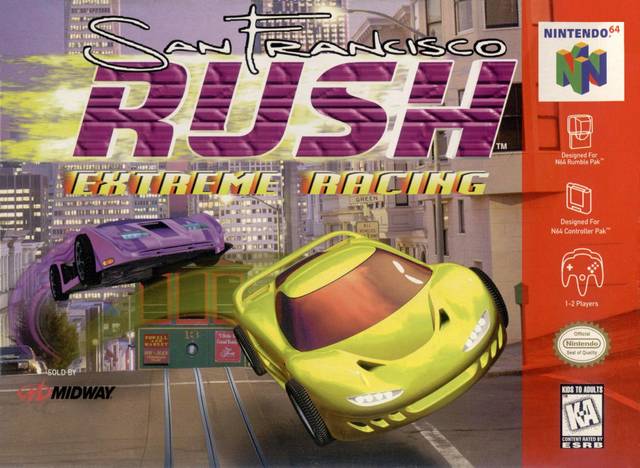
Developer: Midway Games Publisher: Midway Games
Released: November 7, 1997 Rated: E 6/10
For the arcade racing aficionados who perhaps thought that Cruis’n USA wasn’t worth their attention, Midway’s other prolific arcade conversion would arrive a year later in the form of the first San Francisco Rush: Extreme Racing. Localized entirely and hyper focused down to the titular city, Rush opts for a circuit-based foundation around, between, over, under, and through the sprawling city streets and landmarks from every angle and route. It’s a matter of taking the simple controls that make arcade titles easy to pick up and understand and enforcing the need to memorize and make experience-based decisions to achieve success – to make the player feel comfortable behind the wheel but curious about the circuits and tracks they’re driving in.
It’s this concept of layering shortcuts, secrets, and alternate routes throughout each of the game’s seven tracks (six default, plus an unlockable Alcatraz track from the Rush the Rock arcade expansion) that actually makes San Francisco Rush even more acclimated to the home console market than it even was upon its arcade debut. And while it was successful nonetheless at a few tokens a pop, the completely non-traditional manner of not just taking shortcuts and alternate routes when you find them, but testing each one against your own skill set and deciding which ones form your own ideal routes is something hardly achievable in an arcade setting without roll after roll of quarters to carry you through the exploratory runs. Exploring every nook and cranny of the Bay Area will also see the player collecting keys, which add a few extra cars to the garage, and are a nice little bonus collectible that suits players willing to try anything and everything in the games they own.

It’s certainly a rather charming and replayable racer that had a strong presence early in the N64’s life, particularly as it was one of the few games to be ported to the PlayStation after the N64, with the N64 port still being far superior, according to critics especially. But where this first entry loses out is essentially all technical shortcomings. Certainly not a great-looking game, the handful of decent-looking car models would be more forgivable if there was a little more flexibility with paint and decal options, though at least there’s some visible damage that changes on them during a race. And you’ll be seeing your various levels of damage quite a lot, as control is another big aspect holding Rush back from true classic status. This is mostly noticeable when trying to hit shortcuts and alternate routes, including narrow ramps and stunt-like jumps. It’s no surprise that your car can get rather unwieldy when hitting the high speeds that inherently carry a risk/reward factory, but there’s a weight to the vehicles altogether that seems very difficult to reign in, and ultimately can make it seems like you’re being punished by the simplicity of the controls for playing the game as intended and trying to get that upper hand from exploring.

I’d try to deduct points in the content department for the small number of tracks, but in the case of San Francisco Rush, its content is brought over from the arcade, and the tracks are large enough that using the old trick of mirror and reverse iterations to flesh out that area of the game isn’t as absurd as a game built from the ground up for a console. What I don’t like, though, is that the city itself, while clearly done with a lot of care in its layout, still comes off as rather empty without any traffic or other sense of populace beyond you and your opponents. This is made even worse by the fact that Midway utilizes distance fog to help render the game – a concept they amusingly try to play off like a feature, as the options menu has a setting for how much fog you want, with the least amount possible being “low.” Still, you’ll probably get at least a few fun sightseeing moments and memorable shortcuts as you zip across the city to the game’s groovin’ soundtrack to keep from outright disliking San Francisco Rush, in spite of its speed bumps and hiccups. A strong foundation for a series that would maintain prolific status as it practically transitioned to a console-first experience during the time of the N64, this original entry is still probably the most iconic that the series has to offer, and a good entry point for the specific style of racing Midway brings to the table here.
Continuing Legacy
Particularly in comparison to its cousin, Cruis’n, and several other racing franchises that got started on or alongside the N64, Rush has a surprising lack of continuation or palpable influence on the racing genre as we know it today. While the appeal of living, breathing cities to drive around in has something of a seedling here, such modern realizations of the concept have much more in common with Grand Theft Auto, Need for Speed, and Midnight Club, et. al. The Rush franchise only received a single, almost unrecognizable entry following the N64 era with L.A. Rush for PS2, Xbox, and PSP, boasting almost none of the style or features of the arcade originals, and attempting to copy the likes of various tuning-focused street racing titles of the mid-2000s, while using the Rush title for some semblance of brand recognition.
Additional Information
Saves: Controller Pak
Players: 1-2
Compatible With: Rumble Pak
Print Guides: Prima
Aggregate Critical Reception (GameRankings): 82.82%, based on 14 reviews
Other Releases: EU, December 1997
My Streams
Commercials and Print Ads


Gallery