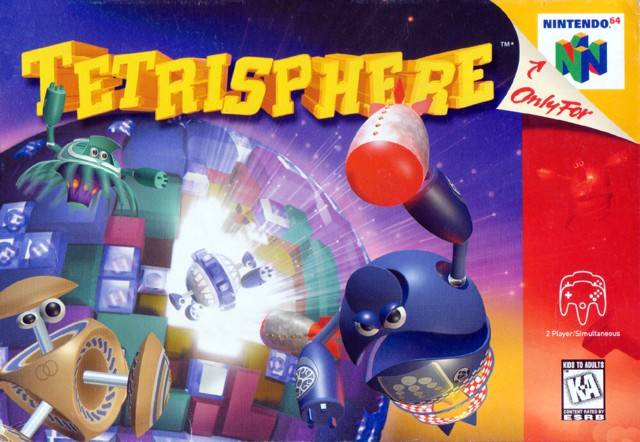
Developer: H2O Interactive Publisher: Nintendo
Released: August 11, 1997 Rated: E 7/10
Another title in the tradition of adding the Tetris branding to various puzzle games released by Tetris Company licensees, Tetrisphere is the first Western release in the underrepresented puzzle genre for the N64. And though it shares a little bit of DNA with the proper Tetris series, utilizing some of the same tetromino shapes in its gameplay, it is of course a largely unique concept, and thankfully one that hits on many of the characteristics of a good puzzler.
As the title suggests, the playfield is set on a sphere rather than being two-dimensional, though it does keep a grid setup with which to align and move the pieces. The primary gameplay process involves placing whichever piece you’ve got lined up so that it matches up a side with an existing piece. You can slide existing pieces around the sphere to align them before placing your own piece, which will cause all adjacent pieces that are lined up to clear at once, and start to clear away the layers of the sphere. This gets us to our main objective of each level, which is to clear away enough of the layers of the sphere to expose the little character trapped inside. From there, it’s not too complicated, just your typical progression of a puzzle game, i.e., initial board setups will get a little bit more complicated, the pieces used will be less versatile, and you’ll be expected to move a lot faster or more efficiently. But the basis for it is extremely simple and very strong, making it very likely to grab you early on and make for an effective and addicting puzzle experience.

Improving and taking on harder challenges, then, follows a fairly typical puzzle game blueprint. You start to see the board faster, see a few steps ahead, and react more quickly to get a higher value play each time. There are also some various mascot characters to use as your chosen player representative, and they offer some very slight variations, but not all that much compared to your general ability to execute your moves quickly. Each of the characters – which can be adequately described as the game’s “blorbos” – has a power and speed stat, which refer to how fast you’ll be able to move blocks while sliding them, and how fast you can move your cursor, respectively. The characters come into play more as the prizes you’re looking to uncover while digging through each puzzle in the various game modes, a lot of which follow typical puzzle game variations. The main game mode, Rescue, is the straightforward version of the gameplay described so far, while Hide and Seek is a mode that offers a few variations of this, like hunting around the sphere for a particular section, or clearing pieces from a few spots on the outermost layer to clear the level. Your other game mode options are a puzzle mode, which limits the number of moves you can make to clear the sphere, and a two player versus mode with the standard mechanic of throwing garbage blocks on your opponent’s playfield after hitting combos.
Tetrisphere is a strong puzzle game because it does what the most effective and enjoyable puzzle games do – it’s extremely simple, both in concept and requiring only a few simple commands to make your moves. It’s also quick, with each level taking only a minute or so and feeling like you want to keep going after each one you clear. Making you feel like you need that level to continue developing your eye for the playfield and your skills at pulling off moves is extremely effective at making this N64 exclusive a must-play for puzzle game fans, even if the connection to Tetris itself is pretty tenuous.

Before wrapping up completely, though, I have to bring up one more true highlight of Tetrisphere that actually does tie it further into the Tetris lineage: the fantastic soundtrack by composer Neil Voss. Consisting of a variety of largely upbeat techno tracks, the score exemplifies the drum and bass or “jungle” style of electronic music that was popular at the time, particularly in video game soundtracks on the N64 as well as original PlayStation. A wide variety of intriguing samples and driving beats really suits the futuristic feel and fast pace of the puzzles, making for a truly noteworthy example of a soundtrack that captures the vibe of the era from the man who would continue his eclectic composition style on The New Tetris shortly afterwards. Even if puzzle games aren’t for you, it is well worth your time to give this soundtrack a listen, if only for some solid background music while working or studying. The 1997 “Best Soundtrack” award from Nintendo Power was well-deserved.
Additional Information
Saves: Cartridge
Players: 1-2
Compatible With: None
Print Guides: None
Aggregate Critical Reception (GameRankings): 85.61%, based on 9 reviews
Other Releases: EU, February 1998
My Streams
Commercials and Print Ads