Developer: Konami Computer Entertainment Kobe Publisher: Konami
Released:December 31, 1998 Rated: T 7/10
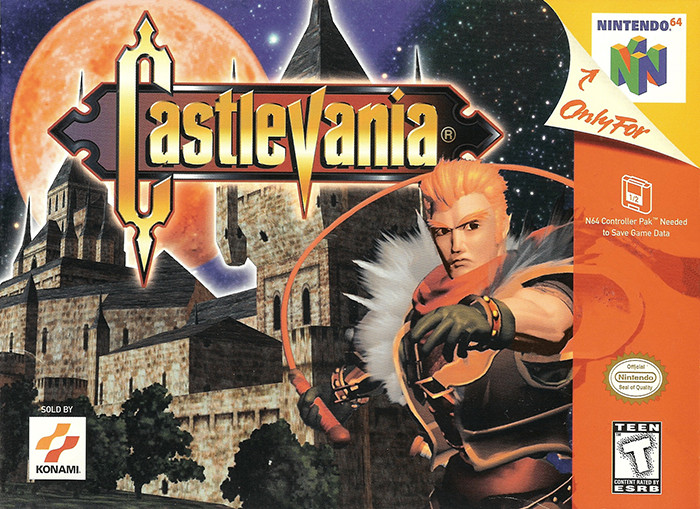
Probably preceded by its reputation to some degree, Castlevania (or Castlevania 64, as many refer to it) is often maligned for two major flaws that have only become more prevalent as tastes continue to change and it’s looked back on more unfavorably, particularly by veterans of the series. Released less than two years after Castlevania: Symphony of the Night, Castlevania declares its intentions right from the start to be as different from its Playstation predecessor and the series as a whole as it can be.

As a transitional title to the fully-3D style, Castlevania comes across as very much “of-its-time,” but because of its awkward adjustments to this style, is only more unappreciated for its successes as time goes on. But while it’s certainly no Super Mario 64 or Ocarina of Time, some great success in moving the franchise forward for others to follow the lead of, Castlevania 64 is far from a failure in the vein of Bubsy or Earthworm Jim as some often seem to believe. And in the wake of such success and refinement as Symphony of the Night had already garnered with the 2D style of the series, and its evolution into the modern Metroidvania style, Castlevania 64’s wide-sweeping transitional changes have only been met with more scrutiny from the franchise’s completionists and more curious devotees.

The premise of Castlevania follows largely in the same vein as the other titles in the series, with this iteration being set in the 1850s as a pair of heroes with differing playstyles embark on a journey to and throughout Dracula’s titular castle to destroy the Count before he can wreak his havoc upon the earth. More traditional whip-wielding players will feel more at home with Reinhardt Schneider, the heir to the Belmont bloodline, while the young magic-wielder Carrie Fernandez offers a slightly different playstyle and alternate set of levels to make a replay of the campaign worthwhile. Taking your character up to and beyond the castle’s outer walls, through the contained villa and surrounding grounds, and up to the castle’s keep to face the demon himself is a slower-paced, more exploratory experience than the straightforward action the series was originally known for. And while Symphony of the Night introduced both an intriguing cast of characters and more intricately laid-out map to become acquainted with, Castlevania 64’s presentation resembles something akin to the Spencer Mansion from Resident Evil, if it were more focused on platforming as part of its gameplay.
The early polygonal space may lack the refined pixel-art style of Symphony of the Night, but Castlevania is far from lacking in beauty and atmosphere. Between an epic and dynamic score that starts off strong from the opening shot of Dracula’s castle in an evening storm, to pensive, mood-setting tracks that accompany scenes of watering the castle garden with blood, presentation is definitely one of the game’s strong suits. Further excellent design sensibilities highlight your trek through Wallachia like an arena-like showdown with a massive demonic bull or a chase through a hedge maze by a chainsaw-wielding Frankenstein’s Monster. Though anachronisms like that and some motorcycle-riding skeletons may stand out and feel a bit odd, the overall feel of the game is as close to a horror title as the usually action-focused Castlevania series has ever done, and is worth experiencing for that alone.


Unfortunately, it’s that platforming and a lot of bad choices that come along with it which typically end up accounting for Castlevania’s failures. Sometimes this is more directly explained by mechanical problems like the classic “bad early 3D camera” but the whole control scheme definitely comes across downright clunky at times. In fact, the number of bad sequences you can attribute to bad design choices and those that are just mechanical struggles are about even. Descending gradually down the sheer face of a bottomless chasm, then climbing back up the other side isn’t an inherently bad section of gameplay, tedious or not. But relying on an inconsistent control mechanic that is supposed to have your character grab onto the ledge and pull themselves up, lest they fall and reset your entire game back to your last save is unnecessarily frustrating and punishing. Meanwhile, there’s a section where you’re attempting to breach the castle wall with explosives. You do this by obtaining the explosive “magical nitro” to mix with another item and blow a hole in the wall. But to get it to its destination, your character cannot take any damage, jump, or fall off a platform, lest the unstable ingredient result in an instant fiery death. Kudos for thinking outside the box, but it’s a slow, anxiety-inducing ordeal of a segment that may have paid off in a true survival horror title, but with Castlevania still sticking largely to the action style, it’s a memorable concept for all the wrong reasons.
Your standard Castlevania trappings are largely here for combat, though it’s another aspect of the game that suffers more from camera and mechanical issues than anything else. The open-area nature of fighting enemies makes things a lot less precise, and it’s that pesky camera that goes the same route as Ocarina of Time with lock-on targeting that falls just short of making up for this. It’s also a departure from traditional Castlevania combat when you consider that enemies are more aware of you across the board, as opposed to fixed obstacles to simply plan around when you encounter them. Combat doesn’t really end up all that difficult, particularly with good subweapons in tow, except that it can be easy to lose track and/or aim of your foes, thanks again to the camera not keeping up or being in touch with what you want.

Like a lot of series at the time, Castlevania had to step forward without seeing where it was going and little existing trail to go on by that point. The fact the series had just had its milestone release only a short time earlier continues to make Castlevania 64 look so much worse by inevitable comparison, but it’s almost unfair that they have to be compared at all. A decade-plus refinement of the formula that had been so successful versus a game that had to figure out exactly what it was supposed to do from scratch. Castlevania 64 is not a great game, but like a lot of other missteps from the era, it certainly didn’t fail for a lack of effort or integrity. And I say that because even if we’d long for it now, I think another Symphony of the Night would have been considered too safe for the time, whereas Castlevania 64 did post modestly successful sales numbers amid scores that were quite kind to it at the time, with most of its negative reputation being attributed to it in hindsight as further 2D entries gained acclaim and 3D entries prior to Lords of Shadows’ total reinvention of the series remained underwhelming as a whole.
Additional Information
Saves: Controller Pak
Compatible With: None
Players: 1
Print Guides: Millennium, Prima, BradyGames, N64 Magazine
Aggregate Critical Reception (GameRankings): 72.71%, based on 12 reviews
Other Releases: JP, March 11, 1999
EU, May 14, 1999
AU, 1999
South America, 1999
My Streams
Commercials and Print Ads


One response to “Castlevania”
[…] a year after its initial release, Castlevania for the N64 would see the release of what we would now consider its “complete edition,” […]