Developer: HAL Laboratory, Jack and Beans Publisher: Nintendo
Released: July 26, 1999 8/10 Rated: E
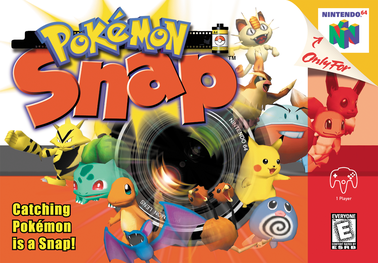
Pokémon Snap contains within it a number of the unique skills Nintendo has for turning numerous small factors into an overall successful project. We start with turning established genres with unconventional framing — in this case, the turning of what is essentially an on-rails shooter and logic-based adventure game into a nonviolent experience via the set dressing of photography. For this, we of course also have to thank the team within HAL Laboratory that became known as Jack and Beans. After a several year development cycle on a project based on and named after Jack and the Beanstalk, the title being worked on was a photo-taking game, albeit with no ties to any actual Nintendo IP. The Pokemon explosion that began with the series’ initial Japan release in 1996 found the title a proper direction and although the use of the N64DD fell through, the eventual release of Pokemon Snap involved as novel a marriage of ideas and trends as Pikmin as an RTS or even Pokemon itself as a clever way to bring children into the world of JRPGs.

In Pokemon Snap, players control new character Todd (who would get a feature episode in the anime, of course) who Professor Oak has tasked with collecting photos of Pokemon in their natural habitats on the biodiverse location of Pokemon Island in order to further develop the Pokedex. To focus entirely on photos and make minimal impact on the species he’s photographing, Todd sits in the ZERO-ONE, a self-navigating vehicle that takes him through a predetermined course through seven different environments throughout the game. In gameplay, this translates to players moving the camera lens around the screen and snapping photos at opportune moments to best display the Pokemon they see. Although there are only seven individual routes to take photos on, a playthough will involve roughly six to eight visits to each area at minimum, as Todd will acquire items to utilize on return visits to coax different reactions and interactions between the Pokemon along each route, as well as trigger certain events to progress further into the game.

Regardless of how it plays, it’s a truly unique concept that would certainly have its fans, even if it wasn’t attached to a literal phenomenon. It’s extremely easy to pick up, as the early portions of the game only focus on taking pictures for the two or three minutes it takes to sit through a route. But it quickly grows addicting with each trip back to a new location as Oak rates your pictures upon your return, prompting you to try and not only capture new Pokemon when you see them, but to solve the puzzle of how to get the best photo of them each time. Adding in the ability to throw food, pester balls (which can agitate or provoke Pokemon when hit), or play the PokeFlute creates a variety of ways to see different behavior and it’s as satisfying to see all the ways you can get a Pokemon to behave as it is to get a high score on their photo from Professor Oak upon your return to the lab. That enjoyment was previously compounded upon release by the ability to take your cartridge to a Snap Station inside a Blockbuster store and print out stickers of your favorite photos. Another classic Nintendo trope of a fun, creative gimmick that feels equal parts benevolent marketing inspiration and cringeworthy corporate synergy, the memory of these big blue boxes is still one of the prevailing features of Pokemon Snap that unfortunately won’t factor in to modern enjoyment, but should be brought up regardless.

Being released between the first Pocket Monsters Stadium (the Japan only one) and the second (the first Western released Stadium), there’s a pretty decently established look for all of the 3D models available for the Pokemon featured in Snap. Much like in those games, there isn’t quite the same charm as there is to be had with the GameBoy sprites, but the establishment of how these characters look in 3D is obviously important and has its own appeal, particularly with the animations against a more natural backdrop. The music is also much more pleasant and natural compared to the battle themes you’ll find in Stadium or the main series titles. The natural settings on the island contribute very well to the calming, nature-film type of sound that may not offer a lot of melodies to hum along to, but are rather distinct in their soundfont and make the setting really come through well.

The only real drawback to be found in Pokemon Snap is, coincidentally, the same complaint to be had with the first console Pokemon game, the aforementioned Pocket Monsters Stadium. There’s just not enough content here to satisfy when the established series up to that point has so much more, on only a GameBoy cartridge. Only 63 Pokemon appear over the course of the game, and while covering all 151 up to that point is a tall order, only 40% is a pretty paltry amount, with only the seven (realistically six, with a bonus final level) routes to explore. You’ll finish the game in only about four hours and other than some of the most difficult to achieve poses for certain pokemon, there isn’t much to stick around for. Thankfully, unlike many of us, you won’t be waiting over 20 years to find anything else that can scratch that itch for more Snap, as the Switch’s New Pokemon Snap finally released in 2021 as one of Pokemon fans most long-awaited sequels ever, myself included. And while the N64 original might come off as a mere proof of concept by comparison, the fact that a sequel was so hotly anticipated for so long should only prove just how well it executes its unique concept.
Continuing Legacy
As mentioned, a sequel to Pokemon Snap eventually arrived on Nintendo Switch in 2021. New Pokemon Snap may be the only true sequel we’ll ever get, but it’s certainly a worthy one. Contrary to the original’s lack of content, New Pokemon Snap is loaded with various species of Pokemon, different routes, bonus level challenges, and different ways to interact and capture the Pokemon included. With both plenty of levels and numerous variations to travel through them, New Pokemon Snap is a game to get lost in as opposed to one to rip through.
Additional Information
Saves: Cartridge
Compatible With: Snap Station
Players: 1
Print Guides: Nintendo Power, Prima, Sybex
Aggregate Critical Reception: 77.05% (GameRankings), based on 22 reviews
Other Releases: JP, March 21, 1999
AU, March 23, 2000
EU, September 15, 2000
My Streams
Commercials and Print Ads


One response to “Pokemon Snap”
[…] Pokémon Snap […]