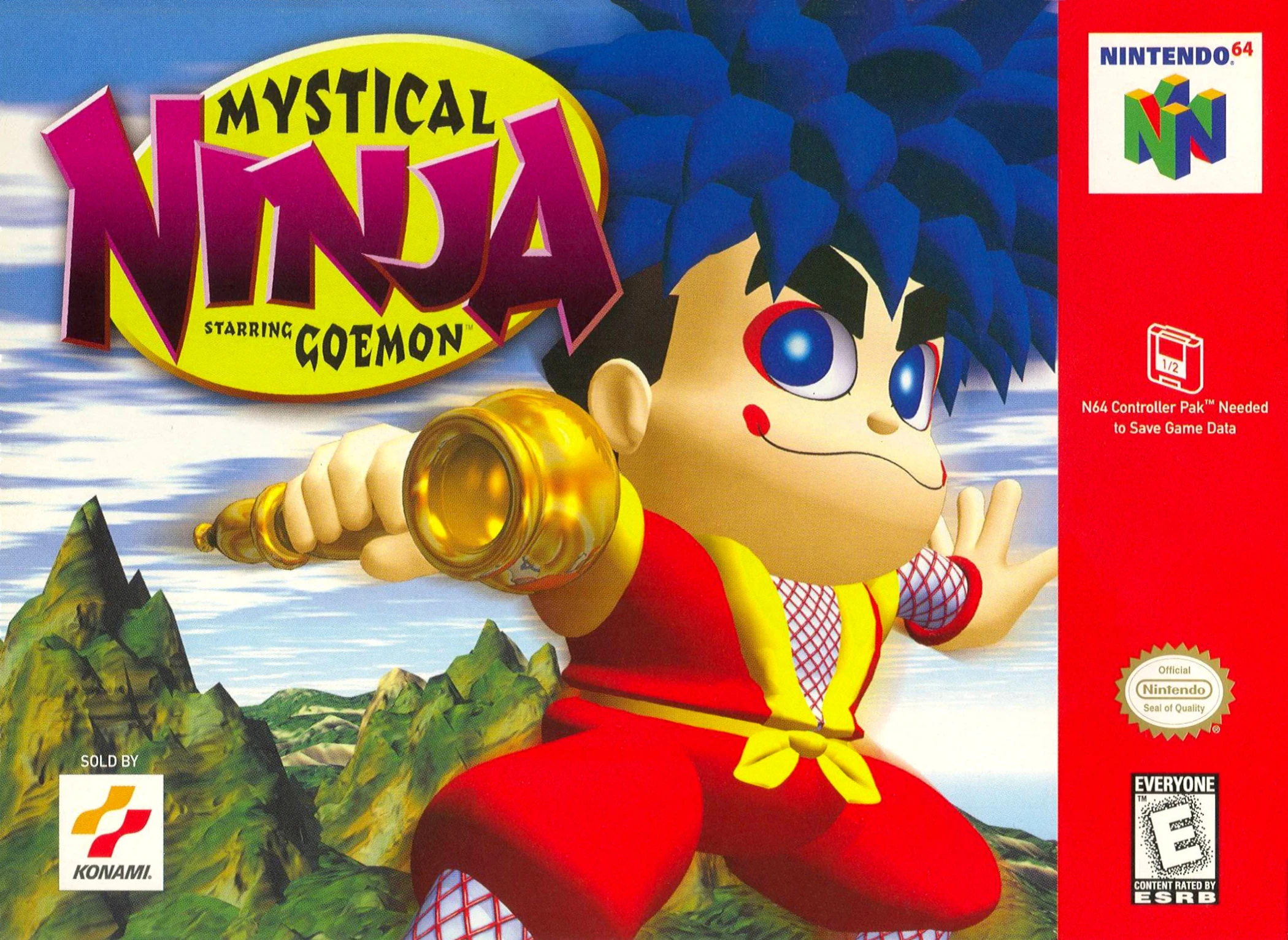
Developer: Konami Computer Entertainment Osaka (KCEO) Publisher: Konami
Released: April 16, 1998 Rated: E 8/10
It’s common to look at great games and series that we missed out on in the West and wonder why they never got localized. Platformers, fighting games, puzzlers – things that can be brought over with minimal translation are always looked at as the big candidates for this when we look back, and are now the more sought after imports for modern day collectors because they don’t take much of a hurdle to play anyway. The Ganbare Goemon series seems to promise a lot of this on the surface – lighthearted action-platforming, boss battles, simple combat, and a small roster of playable characters to highlight different play styles for replayability. But from the handful of titles in the series we actually have gotten localized, including two on the N64, it’s actually pretty clear why it doesn’t fit that profile so easily, and yet that’s a big part of what makes it so special.

Mystical Ninja Starring Goemon is only the second title in the franchise to reach the West, the first since The Legend of the Mystical Ninja on the SNES, and is also the first in the series to be based in a 3D gameplay style. As players control Goemon, Ebisumaru, Sasuke, and Yae in an adventure across Japan, they’ll explore various towns and villages, take on various challenge-laden dungeons, and fulfill the needs and requests of different NPCs and quest-givers. In many ways, it’s a pre-Ocarina of Time Zelda clone on the N64. Though the in-between areas connecting the bustling little towns can be rather sparse, the cycle of these different types of areas – and the occasional giant robot fight – creates a charming and interesting world full of, well, some pretty odd stuff for an E rated game. But that’s what we’re talking about with Mystical Ninja being about more than just platforming, combat, dungeon exploring with puzzles and a big boss fight at the end.
The fictionalized Edo period Japan, loaded with cheeky cultural references and silly dialogue, is a key part of the game that not only won’t come across without any kind of translation, but wouldn’t let you play the game at all if you can’t understand it. Progressing through the game requires interacting with the locals, understanding what items you’re looking for and how to get them, and where to find them, and keeping your eyes open for what’s important along the way. And most of the flavor of the game is rooted in Japanese culture and its contrast to other cultures. This isn’t Phoenix Wright, where one episode per game might take a little bit more learning from the player to understand all the context. It’s a pretty consistent stream of references and parody that defines the entire plot and characters. Even the very silly villains are specifically designed as a contrast to the main setting as they turn landmarks across the region into European style castles and stages for their own performances of singing and dancing.

Slashing enemies with Yae’s katana and slinging across Takeshi’s Castle-like fortresses filled with hazards is rarely too challenging, but the overall adventure blends together pretty well, even if it can be unclear where to go next or exactly what’s going on. It always feels like an adventure with a strong sense of scale and lighthearted tone, and while the vibe might not be for everyone, it’s not for a lack of creativity or presentation. Everything is bright, silly, and jovial. Even the most villainous and perilous scenes are presented like a comic play, with even some dialogue scenes punctuated by a laugh track to drive home that this is very much like a stage show, even in context.

Behind all of this is a frankly excellent and unique soundtrack that hits on the sense of Japanese culture perfectly with both bombastic and quaint tracks that will prove catchy and memorable. The opening theme hits hard like a great anime theme, the melody for which gets reused early on in a much more whimsical town theme that’s just as catchy. Other vocalized tunes like the Impact robot introduction are also unique to the vibes of Mystical Ninja and make for something all the more memorable in the N64 library. It’s just one of many things that Mystical Ninja does that make it unlike anything else on the system, even if the actual genre falls more in line with the open-ended adventures that the system was known for. Even when it’s very obvious from playing it why Konami rarely saw fit to release the series outside of their home market, having the ability to enjoy this defining cultural aspect, or at least look past it on the way to some widely enjoyable and inviting gameplay makes this a title that most fans of the N64 should take a look at, especially considering the type of games that made the console so popular in the first place.
Continuing Legacy
Though it’s a common tale amongst practically all of Konami’s franchises, the fact that Goemon and his friends are primarily used to sell pachislot machines nowadays is especially harsh, since he actually hasn’t been featured in a game since 2005. With 29 titles in the Ganbare Goemon franchise, the fact that this is one of only two titles with a 3D style and that two of those titles were localized to the West for the N64 makes the system feel a bit like the series’ primary home outside of Japan.
Additional Information
Saves: Controller Pak
Players: 1
Compatible With: None
Print Guides: None
Aggregate Critical Reception (GameRankings): 74.21%, based on 14 reviews
Other Releases: JP, August 7, 1997
EU, April 18, 1998
My Streams
Commercials and Print Ads