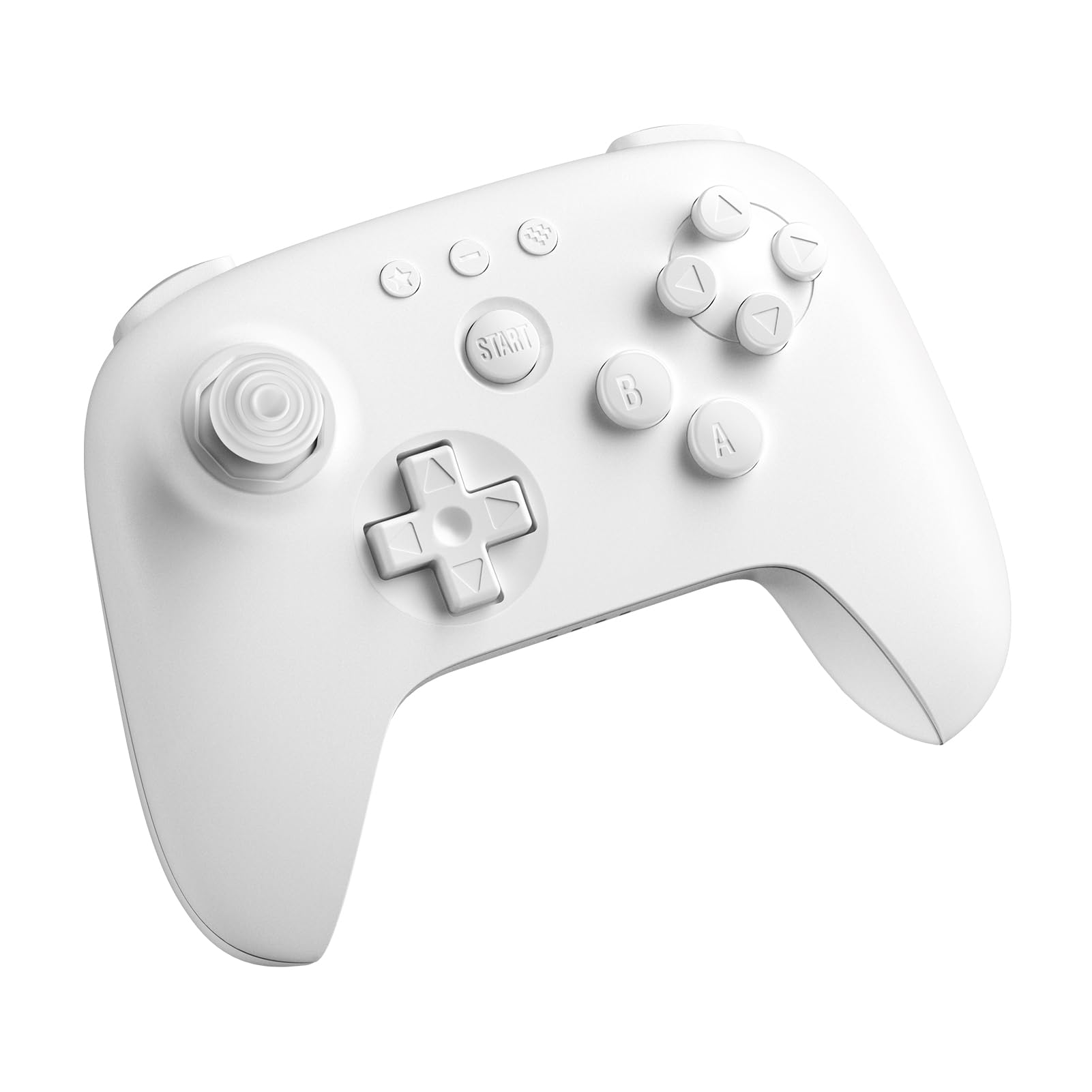
This controller review requires some important notes to preface it. First, at time of writing, it has been nearly 10 months since preordering this controller alongside the Analogue 3D console it was primarily designed for. The controller is in hand and the system supposedly not far behind, but this review is being conducted entirely off of using the Nintendo Switch Online and the library available there. That’s because the 8BitDo Analogue 3D controller cannot be used on your original N64 without some kind of additional receiver to pair it with. This is a Bluetooth/USB-C based controller primarily designed for the unit it is named for and therefore not inherently compatible with legacy hardware.
With that out of the way, there probably isn’t a better way to describe this controller to those familiar with the manufacturer than by saying that it certainly lives up to the company’s standards. It’s a sharp-looking piece of hardware with excellent heft and build quality, comfortable molding, and high-quality buttons, triggers, and analog stick. A quick rundown of features tells the tale of many original controller issues with the N64 being addressed and other modern accommodations fitting right in. Rechargeable batteries, updatable firmware (something you’ll need out of the box to use on Switch 2), and an easily-implemented turbo function are standard for 8BitDo as is, but it’s more specific features that really sell the quality here.

The analog stick in particular will always be the, well, sticking point on any controller design or redesign when talking about the Nintendo 64, and I think it’s fair to say that the work has been put in here. Moving the stick off-center is key with a fair bit of resistance, more so than any other controller I had in my vicinity not made for the N64, but it conveys a tightness that the original design always had with its stiff plastic sticks and a robustness to the build that is backed up by the metal ring reinforcing the short, GameCube-esque shaft against each of the corners of the octagonal gate. A test done by other users to demonstrate the window of the stick via the joystick testing tool conveys objective perfection in the performance.
The included rumble feature is a brilliant touch that, while only available via Switch and Analogue 3D, solves a problem that dates back to the original N64 hardware as well, eliminating the need for Pak swapping and, really, accessories as a whole on newer hardware given the advantages of save states. Obviously it’s not too difficult to mimic the Pro Controller when playing on Switch, but knowing this will translate to all Rumble Pak usage on the Analogue is extremely enticing considering how many third party titles are just too much of a hassle to hot swap when you have to save on a Controller Pak.

Button layout on the face is another big success here, as the buttons are large and comfortable, with the proper layout that the Switch itself is most lacking in (C Buttons are below face buttons and the stick on the Pro Controller is a paltry replacement for a button press). And there’s something particularly charming about the font on the Start button being just right. Of course, as with all of these two-handled N64 controller redesigns, it’s the triggers and D-Pad where I have to give warning. Though the D-Pad itself is a borderline perfect recreation of the original, it’s still never going to be comfortable for games that use it as the primary control method. This means, once again, that puzzle games, wrestling games, and Mischief Makers, to name a few, will always be better in the original design.
Triggers, once again, are an inescapable gripe, with the Z button being moved from its most natural position on the back of the controller to each rear shoulder button. This will cause less issue on the Analogue, I imagine, when both of them will actually have the same function, but on other platforms, like the Switch, your right trigger will still register as ZR and open the menu, while only your left trigger will function as Z and the left shoulder as the seldom-used L button. This is far from an unsolvable issue, as any decent platform, emulator, and even the controller itself will allow for remapping as you like. It is, however, another inescapable issue to deal with as needed that the two-handle redesign inherently creates. Even when laid out the way you prefer, there’s always a speed bump this design creates where the use of the shoulder buttons doesn’t immediately come as second nature.

Though most of its competition is no slouch — Retro Fighters, HORI’s original Mini Pad, Retro-Bit — it’s hard to imagine that 8BitDo is anything but the top option, save for the fact that it’s designed for everything but the original hardware. If you’re playing N64 games on anything but the original console, this is probably your best bet. Its flaws are inherent to its insistence on joining the redesign club rather than remaking the original, so everything it does it still manages to do as good or better than its competition. At $39.99, it’s still an extremely good price point, right in line with its best competition and with other items in the 8BitDo catalog.
I’ll finish this off with a quick list of notes about particular moments I experienced while playing some of these games:
- Super Mario 64 is obviously the litmus test as always. It’s funny how between playing Nostalgia 64 recently and countless instances of testing less than perfect sticks here, I almost felt like I didn’t know if this was right at all. I overran so many jumps and platforms right away I felt lost but after some of the inclines slowed me down I locked into the movement speed a lot better and felt more in sync with things.
- Mario Party as a series is arguably the best way to test one of these things out, as you’re going to use most of the non-C buttons in so many little ways. Slot Car Derby is still my nemesis but it wasn’t over a lack of control. Free-moving games like Bombs Away and Lava Tile Isle felt just right.
- Star Fox 64 becomes kind of a mess with barrel rolling and tight maneuvering due to the shoulder buttons, but having the C-buttons properly laid out is a godsend compared to the default Switch controls.
- Mario Kart 64 felt great, actually. Analog stick feels just right and pulling off power slides (in a game where I think the mechanic is actually kind of wonky) is just right, given the context.
- Mario Golf isn’t the most intense feature testing you’ll get, but adjusting the impact point wasn’t too difficult when needed.
- The Legend of Zelda (either game) is as natural as any 3D movement but once again the Z-targeting will drive you crazy when your brain doesn’t lock into it.
- Goldeneye and other FPS titles are probably the biggest struggle, especially when they use the stick and C-buttons in tandem. My brain simply can’t process the functions of my hands being flipped with this more traditional shape of controller. On a regular N64 controller my brain has an FPS mode implanted in me at a young age due to Turok. Playing Turok with this controller completely subverts that when movement is on my right and aim on the left.